
Reviewed · POMPEII DAY TRIPS FROM SORRENTO
Skip-the-Line Pompeii Guided Tour from Sorrento
Pompeii is easier when the line is gone. This guided, skip-the-line half-day from Sorrento gets you onto the ruins fast, then walks you through the places that explain how a Roman city actually worked. You can also choose a morning or afternoon departure depending on your pace, and I like that guides on this route have ranged from LuLu to Nello, all focused on making the sprawling site feel navigable.
What I love most is the air-conditioned coach between Sorrento and Pompeii, which keeps the day comfortable before the walking starts. I also appreciate the skip-the-line admission, plus the included guide time inside the park, so you are not spending your limited hours hunting down tickets or waiting outside.
The main drawback to plan for is physical reality: you will cover uneven stone, steps, and inclines, and one review specifically notes wheelchairs are not allowed even though strollers may be. If you need a slower, flatter route, you will want to think twice.
In This Review
- Key Things I’d Watch Before You Go
- From Sorrento to Pompeii, the Comfort Factor Actually Matters
- Morning vs. Afternoon, Choose Your Tradeoffs
- Why Skip-the-Line Changes the Whole Pompeii Day
- How the Guide Tour Actually Works Once You Enter
- The Forum and Temple of Jupiter, Where Power Showed Up
- What You Should Look For
- Time Reality Check
- Macellum and the Business of Everyday Food
- Via dell’Abbondanza, Pompeii’s Main Street Energy
- A Photo Tip That Helps
- Stabian Baths, Private Time in a Public Place
- Why This Stop Works
- The Lupanar, A Look at Pompeii’s Most Famous Side Street
- A Thought Before You Go
- House of the Faun and Alexander Mosaic, Wealth Made Visible
- Basilica in the Forum, Business and Justice Under One Roof
- Teatro Grande, Greek Forms in Roman Streets
- What the Tour Duration Really Means for Your Day
- Price and Value: What You’re Paying For
- Practical Tips That Will Make Pompeii Feel Easier
- Should You Book This Pompeii Tour From Sorrento?
Key Things I’d Watch Before You Go
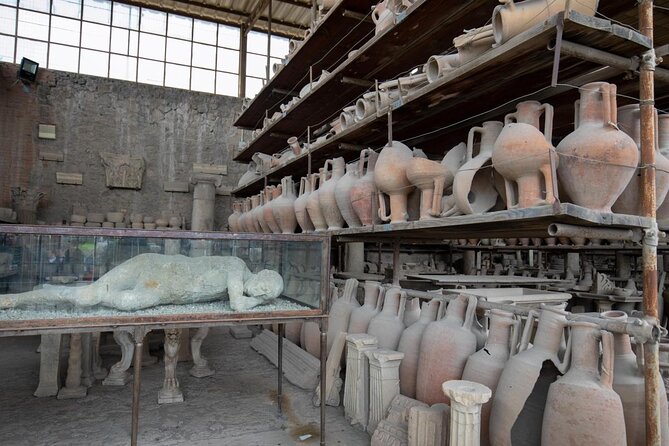
- Skip-the-line entry so you can head straight into Pompeii instead of losing precious hours outside
- Comfort on the transfer, round-trip transportation by air-conditioned vehicle from Sorrento
- Headphones for bigger groups, included in Pompeii when your group is over 10
- A focused highlights route that hits the Forum, main street, baths, Lupanar, mosaics, and the theater
- Small group size, up to 29 people, which usually keeps the tour moving
From Sorrento to Pompeii, the Comfort Factor Actually Matters
The best part of this tour starts before you ever step into Pompeii. You meet in central Sorrento at IAMME IA! – Gray Line Amalfi Coast, Piazza Torquato Tasso 16, and then you ride round trip by air-conditioned coach. For many people, that simple comfort is the difference between arriving alert and arriving cranky.
Pompeii’s ruins are spread out, and the route you follow depends on time. A structured transfer and a timed entry help you make smart use of your half-day. Reviews back this up with comments like the bus pickup being on time and groups getting among the first into the site, especially on early departures.
Morning vs. Afternoon, Choose Your Tradeoffs
You have morning or afternoon departure options. I strongly prefer morning if you want to avoid the worst crowds and the heat. One review flat out calls the early tour the way to go because Pompeii gets crowded and warm as the day moves on. Afternoon can still work if you are okay with more people in the same photo spots, but you may feel more rushed at certain stops.
Walk streets frozen since 79 AD
- Sorrento: Skip-the-Line Pompeii Express Tour by Train
★ 4.8 · 2,038 reviews - Priority Access Pompeii & Mt. Vesuvius Full day from Sorrento
★ 4.5 · 1,376 reviews - Pompeii Express Guided Tour by Train from Sorrento
★ 4.5 · 770 reviews - Pompeii Ruins Half-Day Tour from Sorrento with Guide
★ 4.0 · 714 reviews
Why Skip-the-Line Changes the Whole Pompeii Day
Skip-the-line is not just a convenience. At Pompeii, time is part of the experience. You are given a guided overview across the highlights, but each stop is time-boxed. The main Pompeii portion runs about 2 hours, and several landmark photo stops are brief, around 10 minutes each.
Without pre-arranged entry, you risk spending that time in queues or dealing with ticketing chaos. With skip-the-line admission included, you can spend your energy on the city itself: streets, buildings, mosaics, and all the everyday details that make Pompeii feel less like a museum and more like a real place caught mid-life.
There is another practical benefit too: being early helps your guide manage the group. More time inside usually means better pacing and fewer moments where you feel the tour is constantly catching up.
How the Guide Tour Actually Works Once You Enter
This is a guided experience with official admission included and an English-speaking guide (with the option that your guide may be multilingual). The tour uses a clear route through several famous points rather than trying to cover everything.
Because Pompeii is huge, guided structure matters. Multiple reviews mention that the guide helped the group avoid getting lost in the street network. Another common praise point was guides making the place feel alive by pointing out details you might miss on your own, including how buildings connect and what you are looking at.
If you are in a group bigger than 10, you get headphones in Pompeii. That matters more than you might think, especially when you are walking and turning corners. You are not forced to crane your neck toward the person at the front.
The Forum and Temple of Jupiter, Where Power Showed Up
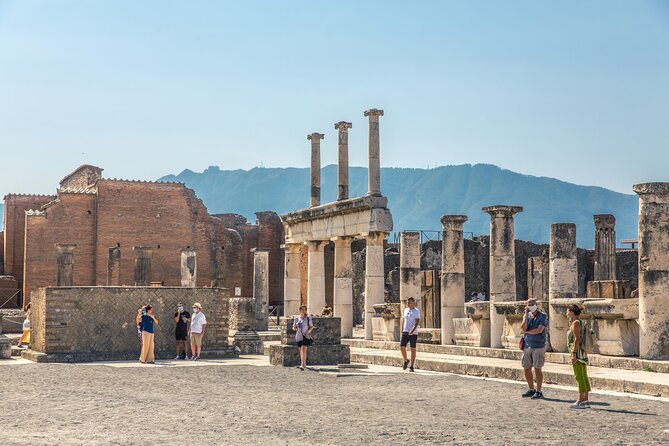
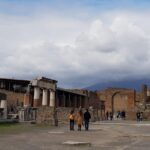
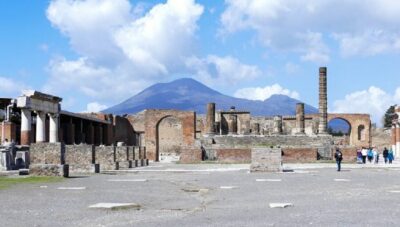
Your first big time block in Pompeii focuses on the heart of civic life: the Civil Forum and surrounding landmarks. This area is described as the core of daily city administration and justice, business management, trade activity, and citizen worship. In other words, this is where decisions happened and people gathered.
From here, the tour includes the Temple of Jupiter on the north side of the Forum. When Pompeii became a Roman colony around 80 BC, the temple was renovated and developed into a kind of Capitolium style complex associated with Rome. The three cult statues of Jupiter, Juno, and Minerva were placed on a high base so they could be seen from the Forum square.
No queues, straight to the good part
What You Should Look For
At a stop like this, your guide’s job is to translate stone into story. You will get a sense for how Roman religion, politics, and public life were physically tied together in the same public spaces. The scenic element also helps: Mount Vesuvius rising behind the Forum gives you a powerful visual sense of why this city froze in time.
Time Reality Check
This stop is part of the early Pompeii overview. Even if you want to linger, you will likely move on fairly quickly. If you are hoping to read every inscription like a detective, you will not have that kind of time on this route.
Macellum and the Business of Everyday Food
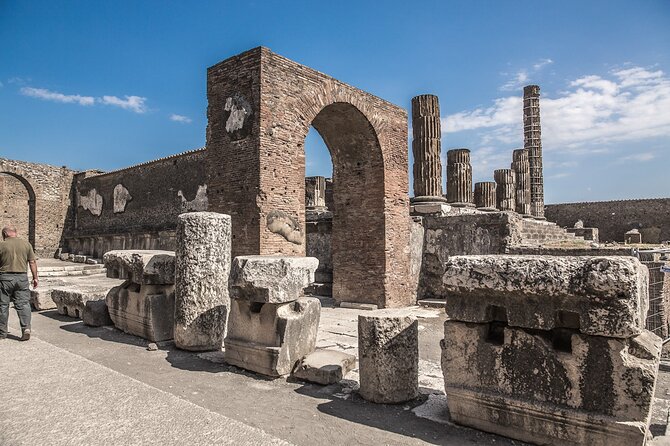
Next is the Macellum, a market complex. The name may not be familiar, but the function is easy to imagine: people came here for food and also for social movement around the food.
The details here are the kind that make Pompeii click. The Macellum is described as a tuff quadriporticus with an elevated hall for worship. You also get references to copies of marble statues in niches, plus signs of an imperial cult connection. On one side, there is also a large room with a masonry counter that could have been used for fish sales.
If you like history that feels practical, this is the kind of stop that delivers. You start seeing patterns: food, status, religion, and trade all intertwined in one building type.
Via dell’Abbondanza, Pompeii’s Main Street Energy
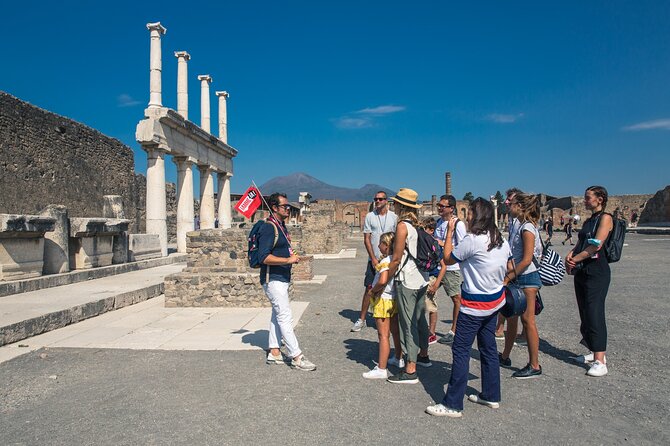
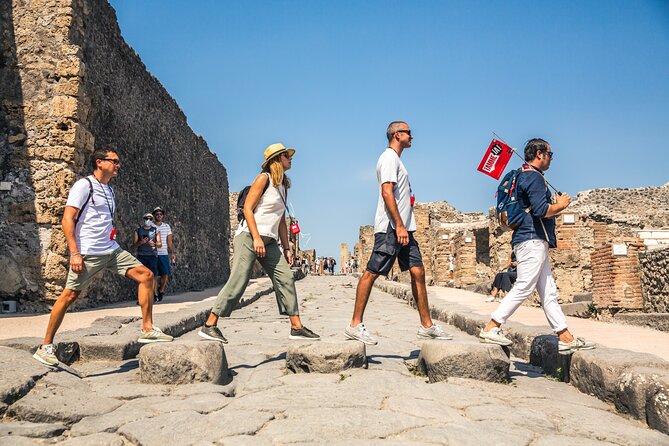
Then you walk (briefly) down Via dell’Abbondanza, Pompeii’s main street. This was the decumanus maximus running east to west, linking the Forum area toward the Porta Sarno.
The street is described as crowded and loud in ancient times, lined with shops and workshops, cafes, snack bars, and restaurants. The guided moment here is short, around 10 minutes, but it serves a big purpose. It gives you the map feeling you need so the rest of the tour makes sense. You are not just seeing isolated ruins, you are understanding how people moved from the city core to everyday commerce.
A Photo Tip That Helps
Take a few photos, then look again with your head up. This is where the scale registers. If you only shoot and walk, you miss the street geometry that tells you where crowds would have moved.
Stabian Baths, Private Time in a Public Place
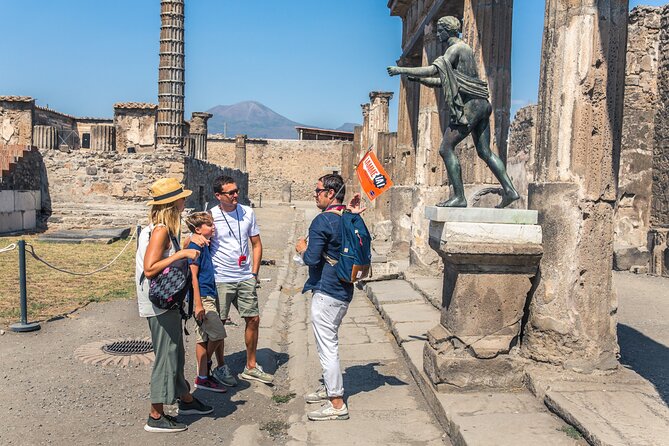
Behind the Temple of Jupiter, the tour includes the Stabian Baths (Terme Stabiane). These date to shortly after Pompeii was founded as a colony of veterans around 80 BC. The guide points out separate quarters, with different entrances for men and women, which tells you a lot about daily routines.
You will be shown the men’s sequence of spaces, including an apodyterium (dressing room) that also functioned as a tepidarium, plus frigidarium for cold baths and calidarium for hot baths. The building was heavily damaged in the earthquake of 62 AD, which also reminds you that Pompeii was already living through destruction and rebuilding before Vesuvius.
Why This Stop Works
This is a good reminder that Roman life was organized, communal, and sensory. Baths were not only about cleanliness. They were about socializing, resting, and moving through a routine that many people shared.
The Lupanar, A Look at Pompeii’s Most Famous Side Street
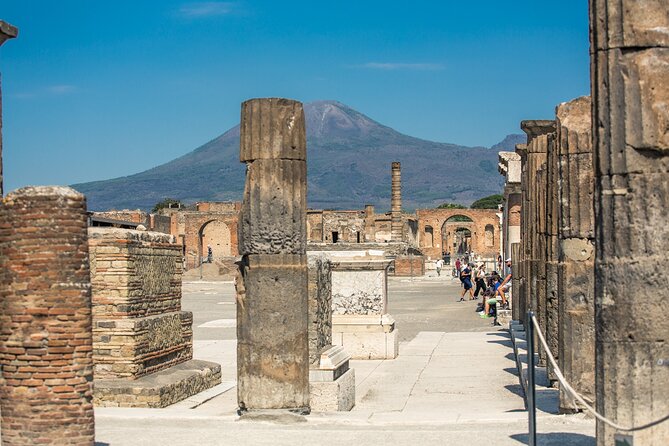
The Lupanar is one of the most talked-about sites in Pompeii, and the tour includes it for about 10 minutes. It is described as the city’s best-known official brothel, a small two-story stone building with built-in masonry beds in multiple rooms.
The most famous feature is the set of erotic frescoes above the doors, often read as a kind of visual menu for services. You also get hundreds of graffiti left by visitors, which gives you raw glimpses of language and daily life among lower-status Romans.
A Thought Before You Go
This stop is historically significant, but it can also feel intense. If you prefer family-friendly interpretation, you might want to check in with your guide about how they frame it. Even with a short visit, the content is unmistakable.
House of the Faun and Alexander Mosaic, Wealth Made Visible
One of the standout stops is the House of the Faun, a large, luxurious residence occupying an entire city block. It is named after a bronze statue of a dancing faun in the main atrium.
This is where the tour gives you a major art-and-wealth payoff: the house is famous for housing the Alexander Mosaic, depicting the battle between Alexander the Great and Darius III. The description includes the contrast of Hellenistic influence with Roman architecture, plus two peristyle gardens and intricate floor mosaics.
If you want one moment where Pompeii stops being abstract, this is often it. You go from streets and civic life to the taste and status of elite households. It’s also a reminder that Pompeii was not only “ruins.” It was a sophisticated city with wealthy tastes and imported cultural references.
Basilica in the Forum, Business and Justice Under One Roof
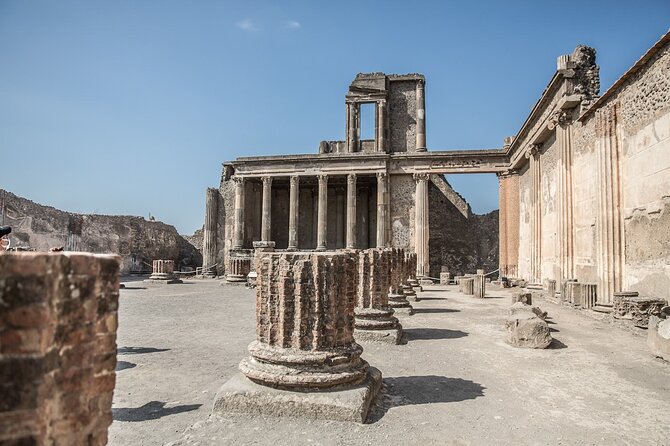
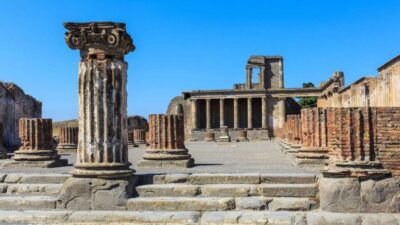
The Basilica is mentioned as the most sumptuous building of the Forum, with about 1,500 square meters of space. This was used for business and administration of justice.
Even in a brief guided stop, the Basilica helps you connect the dots. You start to see why the Forum was not just a religious square or a random open space. It was a work zone, a court zone, and a gathering zone.
Teatro Grande, Greek Forms in Roman Streets
The tour finishes with Pompeii’s Large Theater, Teatro Grande, built by Romans into a slope of a hill. The auditorium is divided into five sectors, and the stage hosted Greco-Roman tragedies.
This stop matters because it changes your view from ground-level daily life to a civic entertainment space. In other words, it adds another layer to what you have learned about how Romans organized culture: speeches, theater, stories, and public emotion all in one setting.
What the Tour Duration Really Means for Your Day
This experience runs about 5 hours. That sounds generous until you remember you are balancing coach time, a guided route, multiple short stops, and time to return.
The itinerary structure is built for efficiency: one longer guided segment in Pompeii, then a string of highlights that keep you moving. It is a smart way to see the best-known sites without turning the day into a marathon.
If you want time to slow down and re-visit details, you may feel constrained. One review notes there was no solo time to wander and that the guide used the full allotted time. That can be great if you want structure, and annoying if you want independence.
So here is the decision rule I use: if you enjoy guided storytelling and a clear plan, this route fits well. If you prefer flexible exploring at your own pace, consider whether you would rather do Pompeii on a schedule that leaves more open time.
Price and Value: What You’re Paying For
At $90.70 per person, this tour is not a budget outing. But it includes several cost drivers that usually add up fast if you do things independently:
- Round-trip coach transfer from Sorrento with air-conditioning
- Official guided entry into the Pompeii Archaeological Site
- Skip-the-line admission, which saves time and stress
- A real guide in Pompeii, not just a generic walking map
- Headphones for larger groups
When you put those together, the price starts to look less like a premium and more like a packaged way to get your money back in time. Pompeii takes effort even with a guide, and time is the scarce resource here.
Also, the tour capped at a maximum of 29 people helps keep it from feeling chaotic. A full coach is still a full coach, but a smaller group size usually makes it easier for the guide to herd everyone toward the right spots.
Practical Tips That Will Make Pompeii Feel Easier
Based on the tour’s route style and what people flagged about the terrain, I’d plan like this:
- Wear sturdy shoes you can trust on uneven stone, because this is not smooth, flat ground.
- Bring a small snack and water since food is not included, even if the schedule allows brief time for washrooms and a snack.
- If you have mobility concerns, treat this as a walking-heavy experience with inclines and steps. One review specifically warns it can be difficult to keep up.
- If early departures are an option, take them. The early start helps with crowds and heat, and it also supports faster entry.
And one more thing: Pompeii is enormous. Even with a great guide, you will not see everything. The tour is designed to give you the high-impact areas in a half-day. That is the deal.
Should You Book This Pompeii Tour From Sorrento?
I think this is a strong choice if you want a guided highlights route and you value efficiency. The skip-the-line entry plus the air-conditioned transfer is a good combo, especially when you are limited to a single day and you want Pompeii to feel readable instead of overwhelming.
Book it if:
- You like a structured plan and clear storytelling from the start
- You want the Forum, baths, Lupanar, and the House of the Faun covered in one go
- You can handle uneven stone and a fairly active pace
Skip it or switch to a different format if:
- You need wheelchair access, since wheelchairs are noted as not allowed
- You want long breaks to roam freely and revisit details slowly
If you hit those conditions, you will likely leave feeling like you finally understood what you were looking at, not just what you walked past.
New on the Sorrento coast






Pompeii Day Trips from Sorrento, compared.

Priority Access Pompeii & Mt. Vesuvius Full day from Sorrento
Read our review →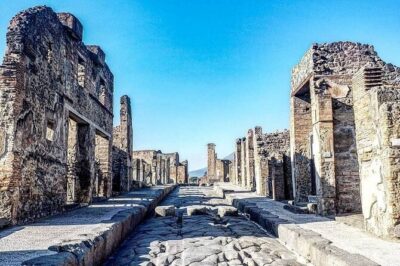
Pompeii Express Guided Tour by Train from Sorrento
Read our review →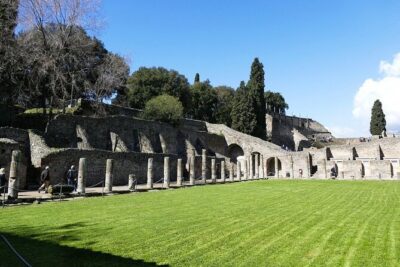
Pompeii Ruins Half-Day Tour from Sorrento with Guide
Read our review →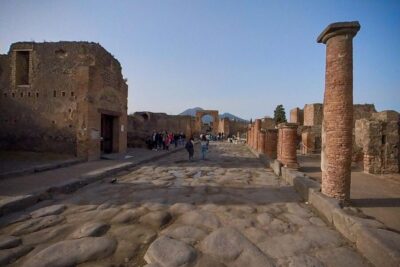
Pompeii and Vesuvius Guided Tour with Lunch
Read our review →
Day Tour to Pompeii Ruins and Mount Vesuvius
Read our review →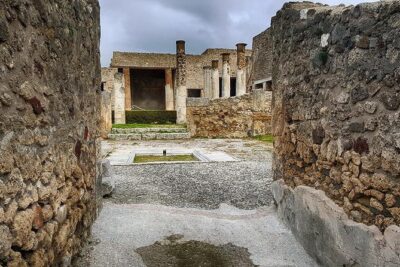
Pompeii and Amalfi Coast Private Day Trip with Pick Up
Read our review →Browse the lists this tour appears in