
Reviewed · HERCULANEUM TOURS FROM SORRENTO
Guided Tour of Herculaneum with Lunch and Ticket Included
Few places feel this well preserved in a day trip.
This guided tour from Sorrento strings together Herculaneum highlights with included admissions, a lunch stop, and a winery tasting in one long outing. You also get fast-track admission tickets so you spend less time waiting and more time looking at what’s actually on the ground.
I especially like the way the day is structured around short, high-impact stops inside Herculaneum, with a guide helping you make sense of what you’re seeing in the preserved streets and houses. I also like the value of the included lunch plus wine tasting, because it keeps the day from turning into a constant hunt for food and tickets. The one drawback to plan for: group size and timing can affect the pace, so if you want a super-small group, you may want to mentally prepare for a larger bus group and some waiting.
In This Review
- Key things to know before you go
- Sorrento start, with views that set the mood
- The ticket-and-guide rhythm inside Herculaneum
- Casa dei Cervi, where you spot the details fast
- Casa di Nettuno e Anfitrite, mosaics worth slowing down for
- Casa dello Scheletro, the stop that grabs your attention
- Sacello degli Augustali, where frescoes do the talking
- House of the Hotel, panoramic setting and a spa district
- Casa del Salone Nero, the party room painted black
- The best reason to have a guide: making sense of the flow
- Sorrento winery stop, with Lacryma Christi on Vesuvius
- Lunch with wine, then a pace that fits a long day
- Getting around: round-trip from Sorrento without the stress
- Group size reality check, and how to protect your experience
- Price and value: why $89.36 can make sense
- Who this tour fits best
- Should you book this Herculaneum with lunch day?
- FAQ
- Is lunch included on this tour?
- What time and how long is the tour?
- Where does the tour start in Sorrento?
- Is the tour in English?
- Are tickets included, and is there skip-the-line access?
- What stops will I visit besides Herculaneum?
- What should I wear or bring?
- What happens if the weather is bad?
- How big is the group?
Key things to know before you go
- Fast-track admission to cut down on time spent in lines
- One guided block of about 1.5 hours inside the archaeological area, then quicker look-and-learn stops
- Lunch included with a starter, pasta main, and homemade dessert, plus a tasting of three wines
- A winery stop on Vesuvius territory with a focus on Lacryma Christi
- A long day with plenty of walking and some climbing, so comfy shoes matter
Sorrento start, with views that set the mood
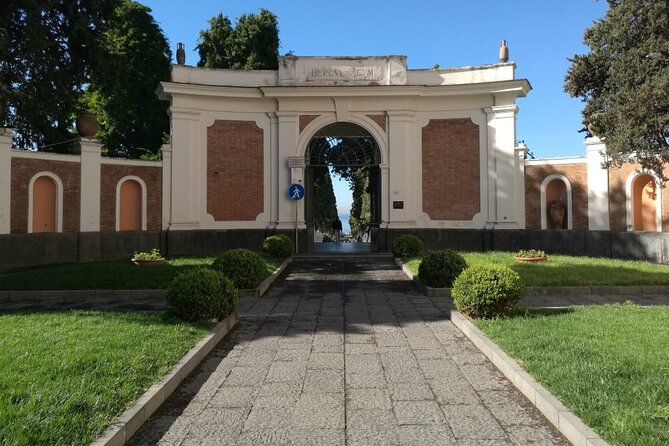
Sorrento begins the day on a tufaceous rock above the sea, and the skyline view is part of the setup. If you’ve only known Sorrento as a postcard town, this is where you get your bearings before you trade modern streets for ancient ones.
You’ll meet at Bar Kontatto on Corso Italia (meeting point: Corso Italia, 257). From there, the group departs from Lauro Square. The payoff of a clear meeting point like this is simple: you avoid early-day confusion, and you’re out the door with the rest of the schedule already ticking.
The ticket-and-guide rhythm inside Herculaneum
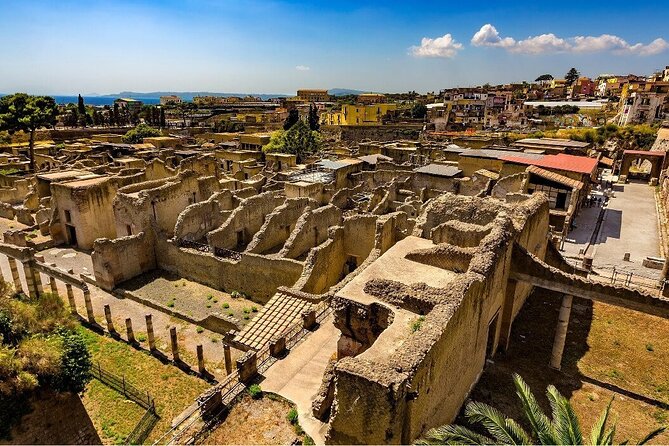
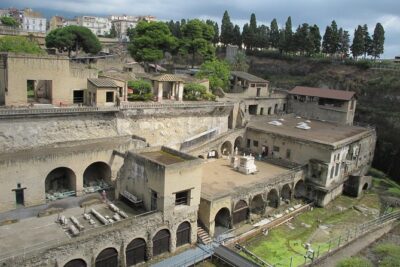
Herculaneum is famous because it didn’t get “ruined the way ruins sometimes do.” It was buried under meters of ash and pumice after Vesuvius erupted in 79 A.D., and that covering is exactly why so much survives. On this tour, the rhythm is designed to keep you moving, but not in a chaotic way.
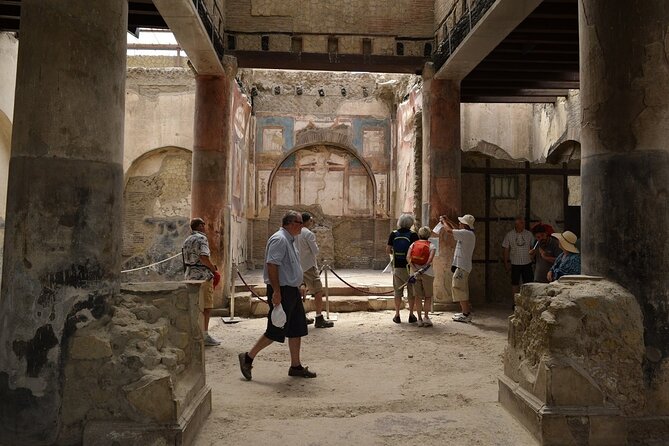
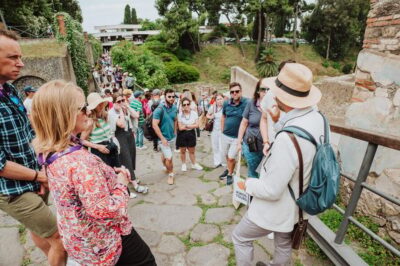
You’ll spend about 1.5 hours guided at the main archaeological area (about 2 hours total at the site on the schedule), with your guide pointing out streets, houses, and the layout that would have shaped daily Roman life. After that, the tour breaks into a chain of smaller house-and-room visits, often around 10 minutes each. That format is great if you want breadth in one day, but you should know what it costs: you won’t linger forever in any single room.
Smaller than Pompeii, just as frozen in time
- Guided Day Tour of Pompeii and Herculaneum with Light Lunch
★ 4.5 · 311 reviews - Sorrento: Pompeii & Herculaneum Tour with Skip-the-Line
★ 4.6 · 125 reviews - Pompeii, Herculaneum and Winery on Vesuvius with an Archaeologist
★ 5.0 · 89 reviews - Herculaneum: 2-Hour Skip-the-Line Tour from Sorrento
★ 4.0 · 46 reviews
Casa dei Cervi, where you spot the details fast
One of the early stops is Casa dei Cervi, named for two deer statues in the garden that were reportedly attacked by a pack of dogs. Even if you just catch the gist at this pace, the stop gives you a sense of how decorative and theatrical upper-class Roman life could be.
The sea-view element is part of the fascination too. Herculaneum often feels like a place that was designed to be lived in, not just visited. At a quick stop like this, you’re mostly learning what to notice, so when you see something later in the day, you’ll recognize it faster.
Practical tip: this is exactly the kind of spot where a good guide matters. If your guide points out what the house name refers to, you’ll leave with more than photos.
Casa di Nettuno e Anfitrite, mosaics worth slowing down for
Next up is Casa di Nettuno e Anfitrite, centered on mosaics in glass paste. The description here matters because it tells you what you’re looking at is not just “pretty floor art.” These mosaics were expensive for the time, and the imagery includes floral and hunting scenes plus the central marine couple, Neptune and Amphitrite.
This stop is where the tour’s quick pacing works in your favor. You’ll see the main motif, and you’ll understand why it’s a focal point in the house. If you’re the type who loves art history but hates museum lectures, this can be a good compromise, because you’re looking at the object while learning the story.
Casa dello Scheletro, the stop that grabs your attention
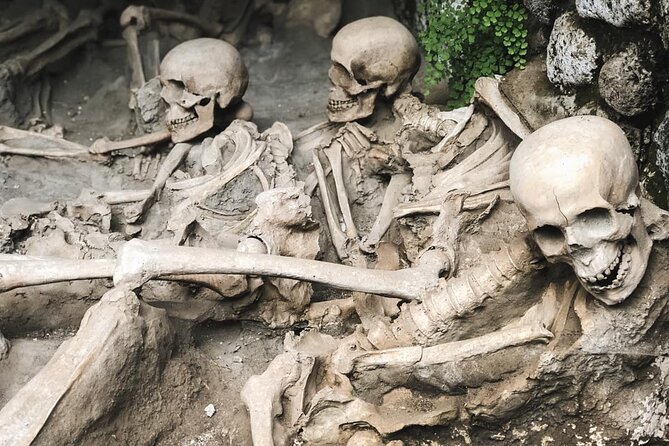
Casa dello Scheletro is named after the discovery of human remains found in a second-floor room in 1831. That fact turns the house from “another Roman home” into something more dramatic and human.
At this stop length, you’ll probably focus on how the name was assigned and why it stuck. It’s not about gore, it’s about how archaeological discoveries can rewrite what we think we know. If you’re sensitive to that kind of subject matter, just be aware this is one of the heavier stops in the chain.
Break for lunch between stops
Sacello degli Augustali, where frescoes do the talking
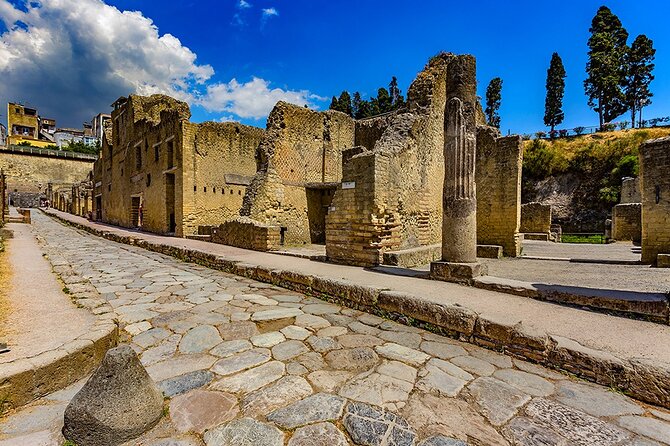
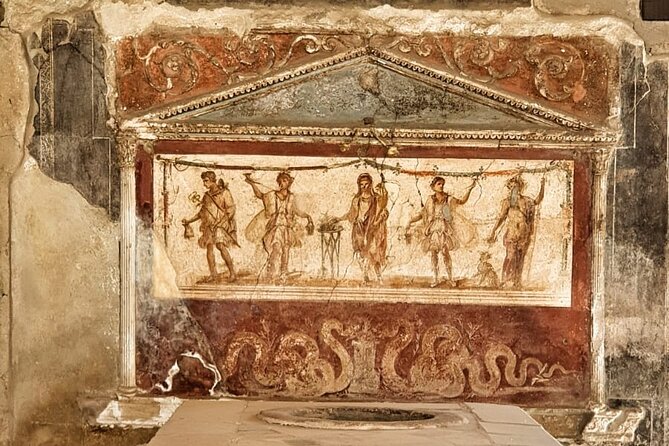
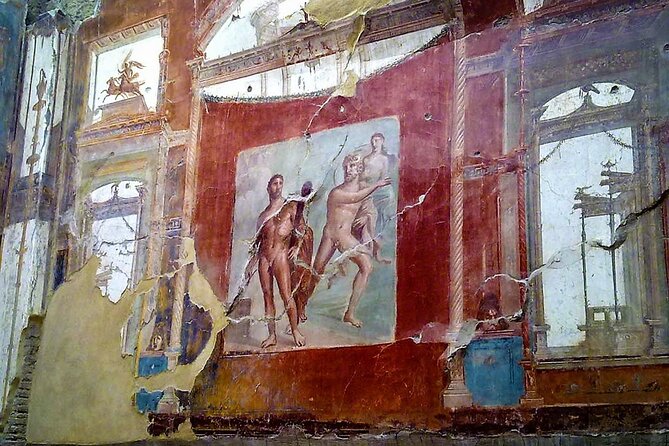
The Sacello degli Augustali is the kind of place that makes you realize how much decoration the ancient world used to signal status and belief. Built near the forum when Augustus was still in power, the small sanctuary preserves frescoes showing Hercules entering Olympus in the company of Jupiter, Juno, Minerva, and Hercules against Achelous.
The scale is smaller than a full house, but the detail level is why it feels so memorable. This is also where a guide’s explanation helps you connect the imagery to who had authority and why public spaces mattered.
A quick note on the “janitor’s skeleton” detail: it’s the sort of grim reminder that the site is not staged, it’s a real moment frozen by catastrophe. If your goal is an emotional connection, these facts are part of the experience.
House of the Hotel, panoramic setting and a spa district
House of the Hotel is one of the biggest surprises on the route. The schedule frames it as the largest house discovered so far in Herculaneum, at about 2,250 square meters, with a panoramic edge-of-the-hill location. It also stood out because it had a spa district, which is why early observers thought it might be a hotel.
This stop gives you a different perspective from the other houses. You get a sense of scale and layout, and you start seeing how these residences weren’t just private spaces. In a place like Herculaneum, you can easily imagine social life happening across terrace, bathing, and reception areas.
Casa del Salone Nero, the party room painted black
Then comes Casa del Salone Nero, named for its party hall painted entirely in black with geometric patterns. This is the kind of room name you don’t forget because it sounds like a theme.
In this house, waxed tablets of L. Venidius Ennychus were found, tied to eligibility for Augustale, the purchase of a slave, and the birth of a daughter. Even at a short stop length, the tablets add a layer that turns archaeology into paperwork you can almost feel. It’s one thing to see decoration, it’s another to know there were legal and social transactions tied to that space.
The best reason to have a guide: making sense of the flow
Herculaneum can be overwhelming if you arrive with only a general idea of what it is. The key value here is that your guide helps you connect the dots between houses, motifs, and the overall city layout.
You might find that the guide style is what makes or breaks the day. One name that has popped up in the guide experience is Roberta, praised for showing everything in the limited time with kindness and practical recommendations. Another guide name you may hear is Emanuela, described as knowledgeable and fluent in English, with helpful tips like where to eat and where to use the bathrooms. You don’t need those exact recommendations to benefit, but you do benefit from that kind of on-the-ground practical focus.
Sorrento winery stop, with Lacryma Christi on Vesuvius
After the archaeological stretch, the tour shifts to a Sorrentino Winery stop. The provided details highlight that the winery operates on Vesuvius National Park land (about 35 hectares), and the signature wine is Lacryma Christi.
What makes this more than a tourist pit stop is the context. The tour connects the day’s theme, Vesuvius, to the local wine that grows in that volcanic environment. You’ll also get a tasting, which fits the day well since you already used your time for walking and reading ruins.
If you like wine, you’ll probably enjoy seeing how a DOC product from Vesuvius is positioned and named. If you don’t, you can still treat the tasting as a short cultural pause and plan to take it easy right after lunch.
Lunch with wine, then a pace that fits a long day
Lunch is included with a sample menu: bruschetta, cured meats, cheeses, seasonal vegetables, and wine as a starter, followed by pasta with Piennolo cherry tomatoes, and a traditional homemade dessert. You’ll also have a tasting of three wines: Prosecco plus a red and a white.
This matters for value because you’re paying for a whole day of logistics. Food that’s already sorted is one less decision and one less line.
It also matters for comfort. A long tour with multiple short visits can turn into fatigue if you’re underfed or dehydrated. With lunch built in, you can concentrate on the ruins and not on finding what’s open.
Getting around: round-trip from Sorrento without the stress
This is a full-day plan that includes round-trip transportation from Sorrento. That helps if you don’t want to coordinate trains, buses, or separate ticketing for each major stop.
On the timing side, you should expect variation. The tour duration is listed around 7 to 8 hours, and the schedule can shift due to local traffic. That’s normal in this part of Italy. The practical takeaway is simple: plan for a late afternoon return, not a quick grab-and-go.
Group size reality check, and how to protect your experience
The price, the included admissions, and the guided segment make this a solid value. Still, one of the key cautions is group size. You may end up with a larger group than you pictured, and that can create waiting time in between transitions.
What can you do about it?
- Arrive early to the meeting point so the day starts cleanly.
- Use the short stop rhythm to your advantage by deciding what you want from each house: art, architecture, or the human story.
- If you’re sensitive to crowds, remember this is a high-demand archaeology outing, and the “fast-track” benefit mainly helps with ticketing lines, not with bus timing.
The tour caps at 100 travelers, but the on-the-ground experience can still vary. If you’re picky about pacing, treat it as a day trip designed for seeing a lot, not as a slow, quiet walk.
Price and value: why $89.36 can make sense
At $89.36 per person, the big question is whether you’re paying for just transport and a ticket. In this case, you’re paying for a package that bundles a lot: guided time inside Herculaneum, multiple included admissions, lunch, and a winery tasting, plus mobile ticketing and fast-track entry.
If you tried to piece this together yourself, you’d likely spend time coordinating transport and buying tickets separately, and you’d still need to figure out lunch. Here, you’re trading some freedom for convenience and a structured day that keeps you on track.
For value-minded travelers, the main “yes” here is: you’re not just buying access. You’re buying guidance to interpret what you’re seeing, and that’s where most visitors feel the difference.
Who this tour fits best
This works best if you:
- Want a one-day introduction to Herculaneum’s preserved Roman homes
- Prefer a guided approach with practical tips instead of navigating on your own
- Like the idea of pairing archaeology with lunch and wine tasting
- Are comfortable with a long outing that includes walking and some climbing
It might be less ideal if you:
- Hate crowds and want a truly small-group feel
- Want deep time in just one or two rooms instead of many quick stops
- Need a very flexible schedule, since traffic can shift timing
Should you book this Herculaneum with lunch day?
If your goal is maximum impact in a single day, I think this is a smart booking. You get fast-track ticketing, a guided block where the site actually makes sense, included admissions across multiple key houses, and lunch plus wine tasting so the day stays easy to manage.
Book it if you’re the kind of traveler who enjoys “see a lot, learn a lot” and you can handle a busy schedule. Skip it or look for a smaller-group option if you know you’ll get frustrated by waiting and a larger bus rhythm. Either way, wear comfortable shoes and plan on a full-body day, because Herculaneum is preserved, but you still have to walk through it.
FAQ
Is lunch included on this tour?
Yes. Lunch is included, with a sample menu that features bruschetta and cured meats, a pasta main with Piennolo cherry tomatoes, and traditional homemade dessert, plus a tasting of three wines.
What time and how long is the tour?
The duration is about 7 to 8 hours. The schedule can vary due to local traffic conditions or other circumstances.
Where does the tour start in Sorrento?
The meeting point is Bar Kontatto, Corso Italia, 257, Sorrento. The tour ends back at the meeting point.
Is the tour in English?
The tour is offered in English. A multilingual guide can operate the tour.
Are tickets included, and is there skip-the-line access?
Yes. Fast-track admission tickets are mentioned, and admission tickets are included for the archaeological stops. The tour uses a mobile ticket.
What stops will I visit besides Herculaneum?
In addition to the Parco Acheologico di Ercolano, the itinerary includes stops such as Casa dei Cervi, Casa di Nettuno e Anfitrite, Casa dello Scheletro, Sacello degli Augustali, House of the Hotel, Casa del Salone Nero, and a Sorrentino Winery stop with a tasting.
What should I wear or bring?
Wear comfortable shoes, and bring sunglasses and sunscreen in summer.
What happens if the weather is bad?
The experience requires favorable climatic conditions. If it’s canceled due to poor weather, you can choose another date or receive a full refund.
How big is the group?
The maximum group size is 100 travelers.
New on the Sorrento coast






Herculaneum Tours from Sorrento, compared.
Guided Day Tour of Pompeii and Herculaneum with Light Lunch
Read our review →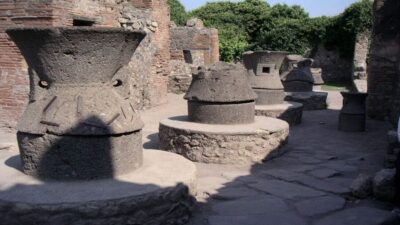
Pompeii & Herculaneum Tour with Skip-the-Line
Read our review →
Pompeii, Herculaneum and Winery on Vesuvius with an Archaeologist
Read our review →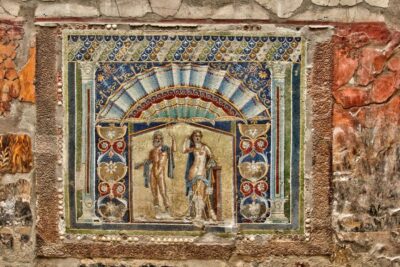
Herculaneum: 2-Hour Skip-the-Line Tour from Sorrento
Read our review →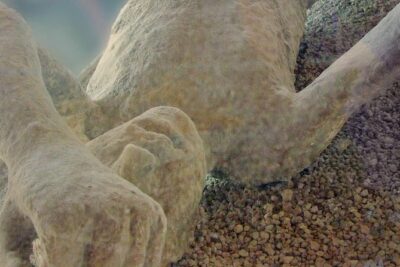
Pompeii & Herculaneum – Skip the line from Sorrento
Read our review →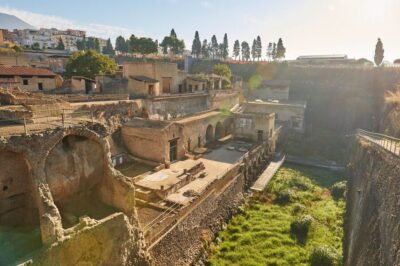
Pompeii and Herculaneum small group excursion from Sorrento
Read our review →
Private Pompeii and Herculaneum Day Tour with Pick Up
Read our review →Browse the lists this tour appears in