
Reviewed · WALKING TOURS IN SORRENTO
Phlegraean Fields: Pozzuoli Guided Walking Tour
Old Rome, less crowded.
This 2-hour guided walking tour around Pozzuoli helps you read Campi Flegrei like a story, from a massive Roman arena to the Roman public market tied to the phenomenon of bradyseism. I like how the route stays focused and human-sized, and I like that you get context, not just stone. The one thing to plan for is the ground reality of this coastline area, some streets and viewing points can be wet or affected by sea-linked flooding.
My favorite part is the Flavian Amphitheater. It is huge, and the guide explains why it took so long to build and what kinds of games it hosted. I also really enjoyed the Macellum of Pozzuoli (Temple of Serapis), because the market setting makes the religious name make sense fast.
One possible drawback: admission tickets are not included, and some areas near the seafront and ancient spots can be hard to access at ground level. You may end up looking at parts from higher streets instead of right at street level, especially if water is involved.
In This Review
- Key highlights you should know before you go
- Pozzuoli and Campi Flegrei: Roman ruins with real-world context
- Meeting at Pozzuoli metro and keeping the start simple
- Flavian Amphitheater: why Nero’s arena took so long
- Macellum of Pozzuoli and the Temple of Serapis
- Pozzuoli’s historic center and the seafront views
- Timing, duration, and ticket strategy that keeps the day smooth
- Price and value for a group of up to 4
- What to wear and how to handle flooded streets
- Who this tour suits best
- Should you book the Phlegraean Fields Pozzuoli guided walking tour?
- FAQ
- Where is the tour meeting point?
- What time does the tour start?
- How long does the tour last?
- What is the price for the tour?
- Is the tour admission included?
- Is this tour private?
- What’s included in the tour price besides the guide?
- How do I access the ticket?
- Is there free cancellation?
- Are there any restrictions on participation?
Key highlights you should know before you go
- Nero-era Flavian Amphitheater storytelling that turns scale into understanding, not just sightseeing
- Macellum of Pozzuoli linked to the Temple of Serapis, including the 1750 discovery of an Egyptian God statue
- Bradyseism explained in plain terms, tied to what you can see in the urban landscape
- A seafront finish with big sea views over Pozzuoli
- A private group format, with a professional guide leading the pace
Pozzuoli and Campi Flegrei: Roman ruins with real-world context
Pozzuoli is the kind of place where history still interacts with your feet. That is the point. Instead of treating ruins like museum objects behind velvet ropes, this walk connects buildings and spaces to what has been happening to the ground around Campi Flegrei.
You’ll hear about bradyseism, the slow rise and fall of the land in this volcanic zone. The guide uses it to explain why certain places feel a bit strange in the way they sit in modern Pozzuoli, and why water can show up where you might not expect it. That makes the visit feel current, not frozen.
I also like the balance of what you see. You get one major set piece, the Flavian Amphitheater, then you move to daily-life architecture in the Macellum area, a Roman-style public market space that also carried deep religious meaning. Finally, you end with the seafront, where the ocean view ties everything together.
If you have already done Pompeii or Herculaneum, this tour works because it does not try to outmatch them in sheer quantity of ruins. It gives you something different: scale and atmosphere, plus a clear explanation of how people lived, gathered, and adapted.
Meeting at Pozzuoli metro and keeping the start simple
The meeting point is at the exit of the Pozzuoli metro station (80078 Pozzuoli, Metropolitan City of Naples, Italy). The tour starts at 10:00 am and ends back at the same meeting place.
Because it is a private tour/activity for your group, you are not stuck in a large herd. That matters here, because you are moving between ancient spaces and street viewpoints, and you want the guide to keep you on track without slowing everything down.
You will also use a mobile ticket, so have it ready on your phone before you meet. Service animals are allowed, and it is described as near public transportation, which is helpful if you are not renting a car.
Timing-wise, it is listed as about 2 hours. At the same time, the tour description suggests you are spending a fair amount of time absorbing the area, so I would plan your day with some breathing room if your schedule is tight.
More Walking Tours in Sorrento
- Walking Food Tour in Sorrento w/ Limoncello Factory Lemon Grove
★ 4.5 · 821 reviews - Sorrento: Guided Walking Tour & Limoncello Tasting
★ 5.0 · 472 reviews - Secrets Walks of Sorrento with a Local
★ 5.0 · 396 reviews - Sorrento: Night time Walking Tour & Limoncello Tasting
★ 5.0 · 155 reviews
Flavian Amphitheater: why Nero’s arena took so long
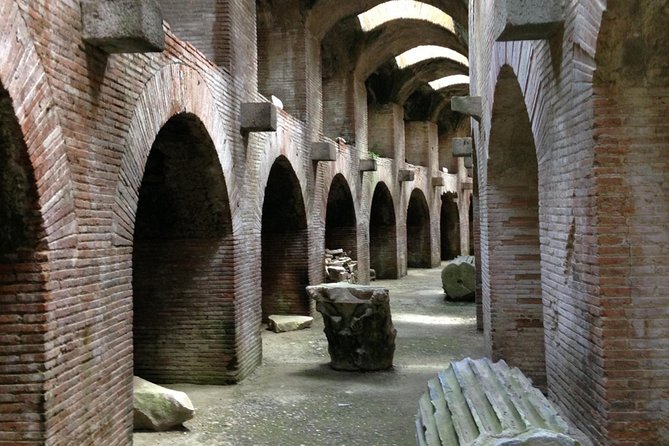
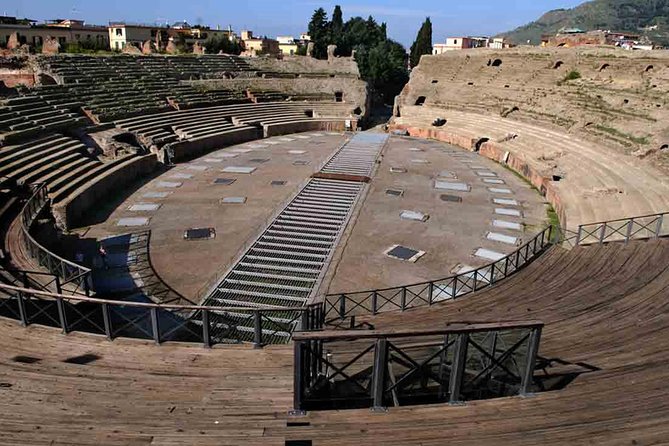
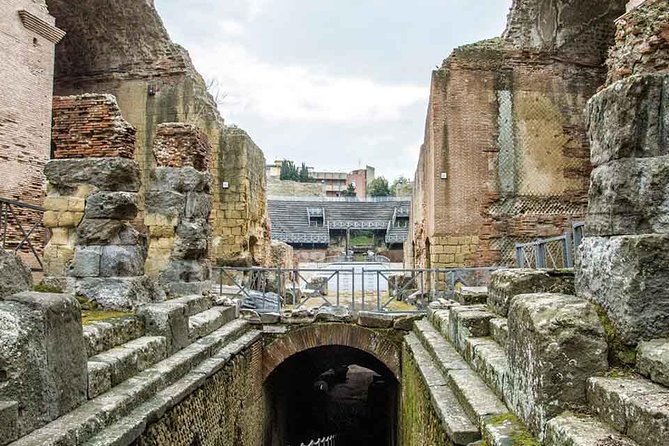
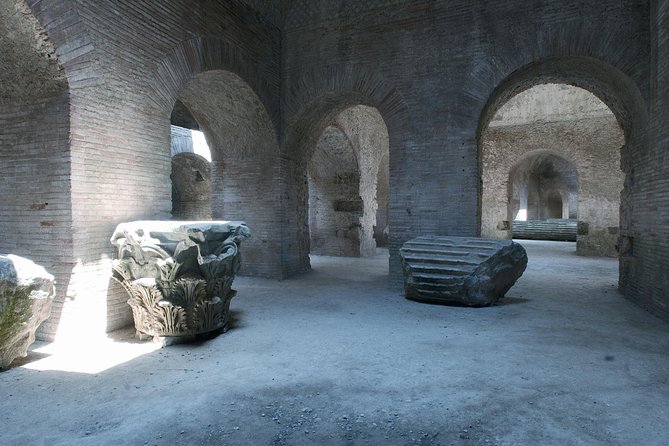
The first stop is the Flavian Amphitheater, the third largest arena in the Roman world. Even if you have seen amphitheaters before, this one is still a real lesson in Roman ambition. It is smaller than the Colosseum in Rome and Capua’s amphitheater, but it is still massive enough that your brain has to recalibrate when you first see it.
Here is what I found most useful: the guide does not treat it like a photo stop. You’ll learn it was built by Nero, and it hosted games in honor of Tiridates, King of Armenia. That connection to a specific political moment makes the arena feel less like abstract architecture and more like power made visible.
You’ll also get time to take it in. This stop is about 30 minutes, which is enough for a first sweep and some explanation without turning it into a long slog.
What to consider: since admission tickets are not included, you’ll want to budget for that extra cost. Also, like many Roman sites, the exact viewing quality can depend on where you can stand comfortably and safely. If the weather or ground conditions are rough, you may not be able to roam exactly where you want, but the guide should point you toward the best angles and the most meaningful views.
Macellum of Pozzuoli and the Temple of Serapis
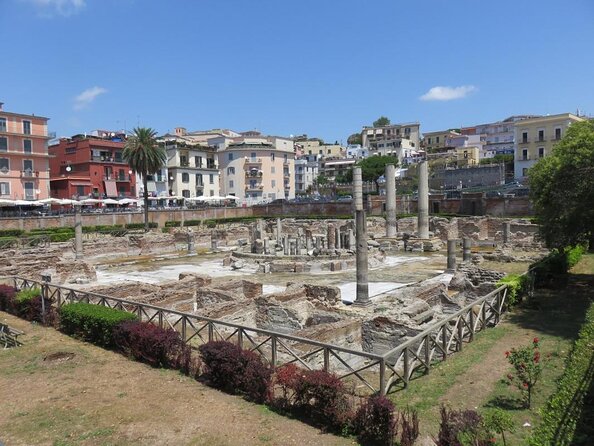
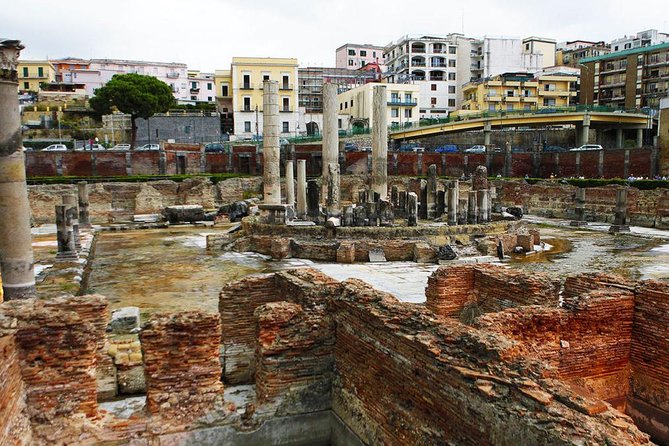
Next comes the Macellum (Temple of Serapis), tied to Roman public life and religious symbolism in one spot. This is the part of the tour I’d call clever, because it explains a Roman contradiction you would miss if you only look at ruins like rubble.
The name comes from a discovery in 1750: a statue of an Egyptian God. Once you know that, Serapis stops sounding like a weird trivia detail and starts making sense as the bridge between different cultural worlds in the ancient Mediterranean.
The guide’s focus here is the “why” behind the place. It is described as a public market of Roman Puteoli, and you’ll hear questions like who frequented it and why this market space connects to bradyseism. That last link matters. It helps you understand how the city’s physical changes affected how people experienced public buildings over time.
This stop is also about 30 minutes. In that time, you can usually do two things well: (1) learn what the space was for, and (2) spot how the ruins relate to the modern street plan nearby.
Just like the amphitheater, admission tickets for this part are not included. Also, this is where water and flooding concerns can show up in the real world. Some vantage points may be high enough that you look at the temple from above the street instead of at ground level. If that happens, don’t treat it as a disappointment. Treat it as part of the story of how the landscape shifts here.
Pozzuoli’s historic center and the seafront views
After the Roman arena and the market-temple area, you move into the historic center of Pozzuoli for about 1 hour. The key value of this stretch is perspective. You stop thinking in isolated monuments and start seeing how the city stitches them together through streets, sightlines, and the way the coastline shapes life.
This is also where you get the bradyseism discussion in a more everyday context. You’ll hear how the slow rise and fall of the ground affects what you see and where you can safely stand. If parts of the area are influenced by sea water, you may notice that the temple and piazza areas can appear partially flooded at times. The guide helps interpret what you are seeing and why it looks the way it does.
You finish with the seafront, with an immense sea view. This ending is practical and satisfying. You spend your earlier time learning how Romans built, traded, and staged public events. Then you end with the environment that shaped everything, the coast and the open water that still drive the reality of the area.
One note from my perspective: this is not a “perfect beach walk” kind of finale. It is a viewpoints-and-streets kind of finish. Dress for coastal weather, and keep an eye on footing if you are walking near wetter spots.
Other ways to see the peninsula
Timing, duration, and ticket strategy that keeps the day smooth
You should expect the tour to run about 2 hours, with the schedule designed around shorter focused stops: roughly 30 minutes at the amphitheater, 30 minutes at the Macellum/Temple of Serapis, then about 1 hour in the historic center and viewpoints.
Admission tickets where required are not included, so factor that into the total cost. The good news is that one of the blocks is explicitly admission free, which helps keep the day from turning into a long, expensive ticket-shopping session.
If you want to keep the tour feeling easy, do two things:
1) Have your mobile ticket ready at the start.
2) Decide in advance how you’ll pay for any required entrance fees, so you are not stopping mid-walk to sort out the payment part.
Also, because it is private for your group, the guide can pace to your questions. That is especially valuable here, since the bradyseism and site interpretation can create natural follow-up questions once you see the spaces in person.
Price and value for a group of up to 4
The price is $289.65 per group, for up to 4 people. That means the real question is not the headline number. It is what you get for the group format you choose.
For me, the value is strongest if:
- You want a guide to connect the dots between the arena, the market, and the bradyseism story.
- You prefer a smaller, private pace in streets and viewpoints instead of a big group march.
- You have already seen other major Roman sites and want a different angle on Campania history.
You also get a professional guide included, and the tour includes a whispers rental from 6 participants and on. If your group booking ends up larger, that headset-style option can make the explanations easier to follow, especially in open-air areas with background noise.
One practical reality: because admission tickets are not included, your final spend will be a bit higher once you add those entrances. But the time value is real. You are paying for interpretation and direction across several key stops, not just for a stroll.
If you are a solo traveler or a couple, you may still find it worthwhile, but you’ll feel the price more. If you can group up with friends to fill the maximum of 4, it starts to feel like a smart, efficient use of time.
What to wear and how to handle flooded streets
Campi Flegrei can be theatrical, and not always in a dry way. One of the most useful pieces of advice I’d give for this area is to stay flexible about viewpoints.
Some areas are described as having parts that are mostly closed at ground level. That can mean you end up looking from a higher point, like from an upper street. If that is your situation, you are not doing it wrong. You are simply seeing the ruins from the angle the terrain allows.
Also, car access can be tricky in certain moments, including situations where areas get flooded. If you are driving, give yourself extra time and do not assume you can pull up right to every stop.
For a smooth experience:
- Wear comfortable shoes you trust on uneven pavement and stone.
- Bring a light layer, since the seafront can feel cooler or breezier.
- If you see water where you did not expect it, treat it as part of the explanation, not a failure of the plan.
And if you are arriving by local transit, note that the area around the Temple of Serapis can be reached from nearby public transport connections. The easiest approach helps you get oriented quickly, which matters when you are walking and learning at the same time.
Who this tour suits best
This is a strong choice if you fit any of these boxes:
- You like your Roman history with a living context, including how the landscape changes.
- You want fewer crowds and a calmer route than you might expect from the big headline sites.
- You prefer a guided walk that explains why a place matters, not only what it looks like.
You might skip it if you want a long, museum-style visit with lots of indoor ruins, or if you strongly dislike walking in coastal conditions that can involve wet streets.
Should you book the Phlegraean Fields Pozzuoli guided walking tour?
I’d book it if you want a smarter way to see Pozzuoli’s Roman core in a short time. The Flavian Amphitheater gives you scale and political backstory, the Macellum and Temple of Serapis connect daily life to spiritual meaning, and the bradyseism angle makes the city feel like more than a backdrop. The seafront ending is a genuinely nice reward after the history.
If you are visiting Naples and want something that feels close to Rome’s grandeur without the same level of crowds, this works. Just go in expecting that some viewpoints may be higher or affected by water conditions, and budget separately for entrance tickets where required.
FAQ
Where is the tour meeting point?
The tour meets at the exit of the Pozzuoli metro station in Pozzuoli (80078, Metropolitan City of Naples, Italy).
What time does the tour start?
The start time is 10:00 am.
How long does the tour last?
The duration is listed as about 2 hours.
What is the price for the tour?
The price is $289.65 per group, for up to 4 people.
Is the tour admission included?
No. Admission tickets where required are not included.
Is this tour private?
Yes. It is described as a private tour/activity, with only your group participating.
What’s included in the tour price besides the guide?
You get a professional guide, and whispers rental is included from 6 participants and on.
How do I access the ticket?
You use a mobile ticket.
Is there free cancellation?
Yes, free cancellation is available. You can cancel up to 24 hours in advance for a full refund.
Are there any restrictions on participation?
Service animals are allowed. The tour is described as near public transportation, and most travelers can participate.
New on the Sorrento coast






Walking Tours in Sorrento, compared.

Walking Food Tour in Sorrento w/ Limoncello Factory Lemon Grove
Read our review →



Sorrento Private Walking Tour with Guide and Limoncello Tasting
Read our review →

Browse the lists this tour appears in