
Reviewed · POMPEII DAY TRIPS FROM SORRENTO
Private Pompeii Tour with Guide & Transfer included from Sorrento
Pompeii is huge, so good logistics matter. This private half-day pulls you straight from Sorrento with round-trip transfer, then gets you into the ruins faster with priority access, so your guide time goes to learning, not waiting. I also like how the pace stays flexible for questions, and you can linger when something clicks, then move on before you overheat. One thing to plan for: Pompeii can feel brutally hot in summer, so shoe comfort and sunscreen are not optional.
What makes this setup appealing is that it is designed for an easier Pompeii day. You get an English-speaking local guide, a private group (just your party), and a route built around the places that explain daily Roman life. The itinerary touches the Forum core, major civic buildings, and a street-and-neighborhood arc that helps the city make sense.
In This Review
- Key takeaways for your Pompeii private tour from Sorrento
- Price and logistics: what you really pay for
- Hotel pickup in Sorrento: the part that saves your day
- Entering Pompeii faster with priority access
- The 2-hour official guide walk in Pompeii: how you stop feeling lost
- Forum of Pompeii: the daily-life center you will recognize
- Tempio di Giove Capitolino, with Vesuvius in the background
- Macellum: food, worship, and meeting space
- Via dell’Abbondanza: the main street where the city felt loud
- Stabian Baths: what daily hygiene and routine looked like
- Casa del Fauno and the Pompeian home world
- Teatro Grande and Basilica: where public life gathered and decided
- Via delle Ville and the Villa of the Mysteries area: a calmer contrast
- Timing, comfort, and pacing: what to expect in the real world
- Who this private Pompeii tour is best for
- Should you book this Pompeii private tour from Sorrento?
- FAQ
- How long is the private Pompeii tour from Sorrento?
- What is the price per person?
- Is hotel pickup and drop-off included?
- Do I need to buy Pompeii admission tickets separately?
- Is priority access included to skip the ticket line?
- Is this tour private or shared?
- What language is the tour guide?
- Is food or drinks included?
- What is the cancellation policy?
Key takeaways for your Pompeii private tour from Sorrento
- Hotel pickup in the Sorrento area, round-trip, so you are not figuring out buses or train schedules
- Fast-track, priority entry, helping you bypass the ticket window line
- English-speaking official guide with live commentary, built for questions as you walk
- Admission tickets included during the Pompeii visits, so you focus on the sites, not payments
- A route through both big landmarks and quieter corners, which is often where Pompeii feels most real
- Summer-proof advice from the start, including comfortable shoes and sunscreen
Price and logistics: what you really pay for
At $504.67 per person for a private tour, this is not a budget option. You are paying for four things that add up quickly if you try to DIY: private hotel transfer, an English-speaking local guide, priority entry into Pompeii, and built-in admission coverage for the stops.
For families, couples, or a small group who want less stress, that cost can start to make sense. Pompeii is a long walking site, and a good guide can reduce your “Where am I going?” time dramatically. That is especially true here because the route is planned as a coherent walk, from the Forum zone outward to houses, theaters, and the bath complex.
Also, timing matters. This kind of tour is often booked well in advance, with an average of about 100 days. If you are traveling in peak months, booking early is a smart move, not a luxury.
Hotel pickup in Sorrento: the part that saves your day
Your tour starts with pickup directly from your hotel in the Sorrento area, then you ride to Pompeii in a private vehicle driven by an English-speaking driver. That reduces friction right away. No meeting at a remote station. No public-transport juggling with luggage or kids.
One practical consideration: some hotels in Sorrento may be hard to reach because of traffic restrictions and pedestrian-only areas. The exact pickup location depends on what is reachable, so you should confirm the pickup point with the local provider at least 24 hours before departure.
You will also receive confirmation at the time of booking, and pickup is described as being near public transportation, which often helps as a backup plan if your hotel is restricted.
More drivers for the coast road ahead
- From Sorrento: Positano and Amalfi Boat Trip with Transfer
★ 4.9 · 1,598 reviews - From Sorrento: Path of the Gods Guided Hike with Transfers
★ 4.8 · 530 reviews - Capri Guided Boat Experience with Island Exploration and Transfer
★ 5.0 · 302 reviews - Private Tour of the Amalfi Coast from Sorrento with Driver
★ 5.0 · 269 reviews
Entering Pompeii faster with priority access
Once you arrive, the big win is the priority access to the Pompeii Archaeological Site. That typically means you avoid the long bottleneck at the ticket window and get moving sooner.
Why that matters: Pompeii is not the kind of place where you can “make time later.” You lose momentum if you burn an hour standing around. With faster entry, your guide can start the story while you still have fresh energy, and you spend the trip actually inside the park.
You will also have a mobile ticket, which is simple for day-of entry. And since this is a private tour, only your group is on the schedule, which helps keep things smooth.
The 2-hour official guide walk in Pompeii: how you stop feeling lost
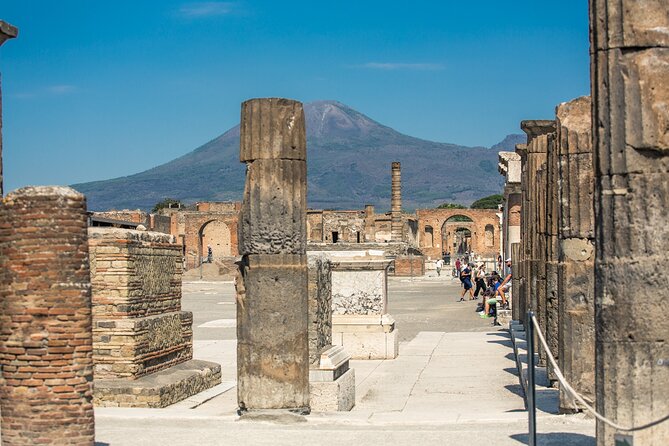
The core of the visit is a walking tour of Pompeii with an official guide for about 2 hours. Pompeii is famous, but that does not automatically make it easy. Streets cross, buildings overlap, and signs are not always where you expect. A guide changes the whole experience because you get the “what you are looking at” and the “why it matters” in real time.
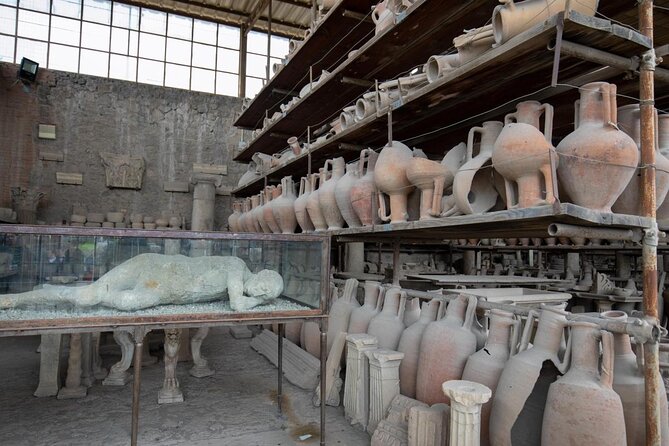
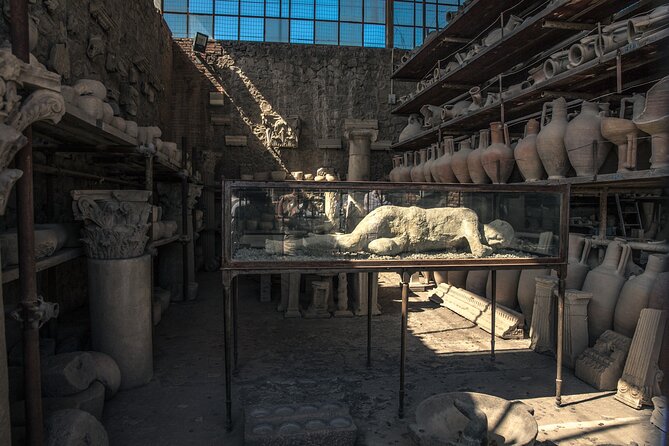
During this guided block, you get a clear explanation of what happened in 79 AD, when Mount Vesuvius erupted and the city was covered by lapilli and lava, which helped preserve structures and everyday details. That is the scientific backbone of Pompeii, and it also explains why so many places feel startlingly specific, down to layout and function.
The guide also matters for conserving and protecting the site. In feedback from people who have taken this route, guides such as Vincenzo were praised for explaining conservation efforts, not just reciting facts. That makes you look at weathering and barriers as part of the story, not as nuisances.
Forum of Pompeii: the daily-life center you will recognize
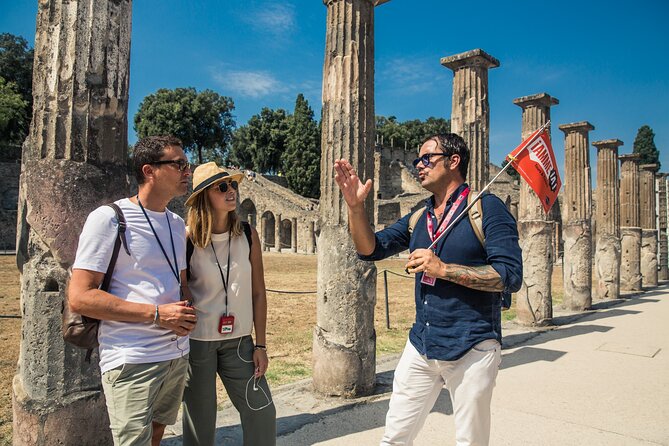
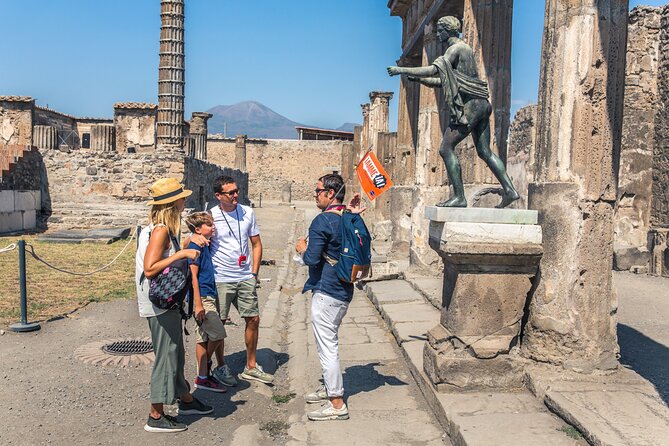
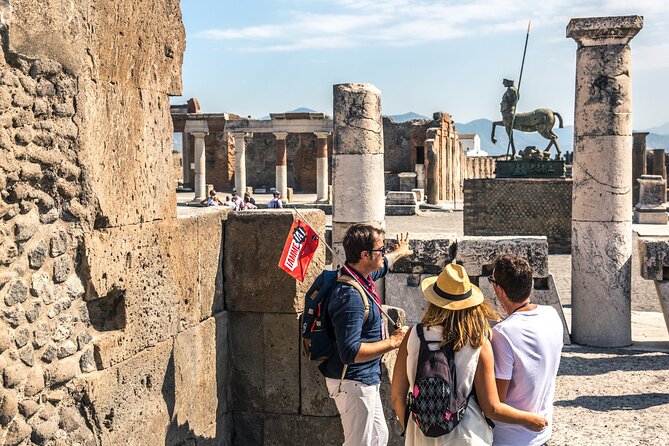
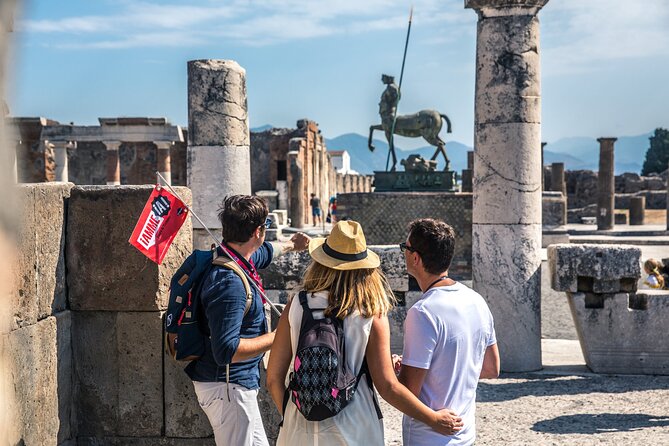
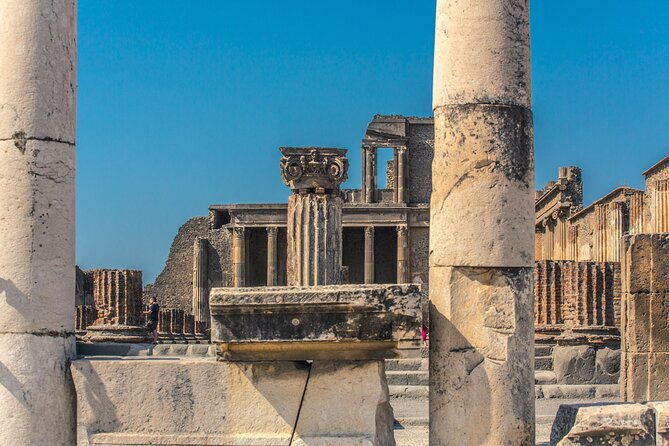
After the initial Pompeii walk, the itinerary keeps you in the civic core with focused stops around the Forum. The civil Forum is described as the heart of everyday life, packed with public administration, justice, business, trade activities like markets, and places of worship.
This is one of the reasons the tour works. You are not wandering randomly. You are moving through the places that explain how Romans handled public life, not just where they lived.
Walk streets frozen since 79 AD
Tempio di Giove Capitolino, with Vesuvius in the background
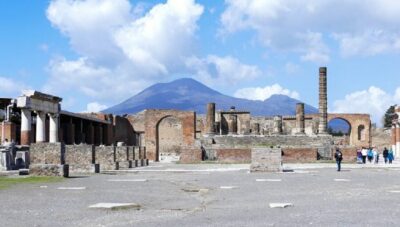
The Temple of Jupiter dominates the north side of the Forum, and on the right day you get a dramatic view with Mount Vesuvius behind it. The itinerary notes that when the colony was founded (80 BC), the temple was radically renovated and became a Capitolium-style complex connected to Jupiter, Juno, and Minerva. The statues were placed high so they could be seen from the Forum square.
Even if you only spend about 10 minutes here, it is a powerful “anchor stop.” You start to see how monumental architecture controlled the look and feel of public space.
Macellum: food, worship, and meeting space
Next comes the Macellum, which the itinerary describes as a tuff quadriporticus with a hall for worship on the elevated eastern side. The stop also points out details that connect food trade with religion and politics. There is mention of marble statue copies in niches, an imperial-cult link, and a room that likely served sacred meetings. There is even a masonry counter that may relate to fish sales.
This is the sort of stop where a guide’s pointing becomes the difference between “I see a building” and “I understand the workflow of the city.”
Via dell’Abbondanza: the main street where the city felt loud
Then you get to Via dell’Abbondanza, Pompeii’s ancient main street. The itinerary describes it as a decumanus maximus running east-west from the Forum to Porta Sarno.
This is where Pompeii feels more like a lived city and less like an open-air museum. The street was described as crowded and noisy in ancient times, with shops and workshops (officinae), plus cafes, snack-bars, and places to eat and drink.
Even if your time here is brief (about 10 minutes), the payoff is big. You get a sense of movement and commerce, and the route links the civic center to the everyday consumer world.
Stabian Baths: what daily hygiene and routine looked like
The Stabian Baths (Terme Stabiane) are placed behind the Temple of Jupiter and date to the period soon after the colony was founded. The itinerary emphasizes separate entrances for women and men, then breaks down the men’s section with spaces such as an apodyterium (dressing room), tepidarium, frigidarium, and calidarium.
The stop is also a reminder that Pompeii was not static. It notes heavy damage during the earthquake of 62 AD. In practice, that can help you read the ruins more accurately, because you understand why things look broken or uneven.
Spending around 10 minutes here can be enough if your guide keeps the focus on function. Baths in Pompeii are not just bathrooms, they are social infrastructure.
Casa del Fauno and the Pompeian home world
The itinerary then shifts toward private life with Casa del Fauno. This is one of Pompeii’s largest and most impressive residences, built in the 2nd century BC. You also get the idea that it was a luxury aristocratic home from the Roman Republic era, and the tour specifically frames it as the kind of residence that helps you understand class and status in Pompeii.
A stop like this is valuable because it balances the civic and commercial parts of the day. After you have seen markets, temples, and major public spaces, a mansion tells you what wealth looked like in stone, courtyards, and art.
Teatro Grande and Basilica: where public life gathered and decided
Two more highlights round out the civic theme. First is Teatro Grande, the Large Theater. The itinerary describes it as built by Romans on a hillside with a structured auditorium divided into five sectors, taking advantage of the natural depression of the mountain. It also notes tragedies from Greco-Roman traditions were performed on the stage.
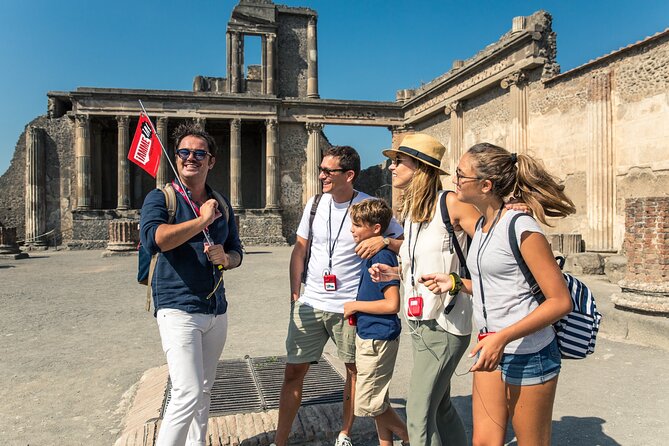
Then comes the Basilica, described as the most sumptuous Forum building and covering about 1,500 square meters. Its job was business and administration of justice. This is the place where you start seeing how Rome blended public authority with daily work.
Even in short stops (around 10 minutes each), these locations help you map the city’s power structure.
Via delle Ville and the Villa of the Mysteries area: a calmer contrast
After the main Pompeii core, the itinerary includes Via delle Ville, often called the path to the Villa of the Mysteries. This road sits outside the city walls, leading away from the Porto Ercolano gate and connecting the urban center to the suburbs, passing through a necropolis with impressive tombs.
Your big connection here is the Villa of the Mysteries, described as a suburban estate famous for frescoes depicting Dionysian rites. This part of the route is a different mood from the Forum. It feels more open, more atmospheric, and it can be a welcome break from the densest clusters of stone and crowds.
The tour format keeps it manageable within a 4 to 5 hour window, so you still finish the day feeling you saw real variety, not just one neighborhood loop.
Timing, comfort, and pacing: what to expect in the real world
The tour runs about 4 to 5 hours. In hot weather, that is long enough for the sun to matter, short enough that you can recover without feeling destroyed for the rest of your day.
I like that the guidance includes basic comfort planning: wear comfortable shoes and use sunscreen. That is exactly what you want to hear before you step into Pompeii’s sun and uneven stone.
Because it is private, your guide can manage pacing. One reason this tour gets strong feedback is that the guide does not rush you through the stops. You can ask questions, slow down when a building grabs you, and still keep the route coherent.
Who this private Pompeii tour is best for
This is a great fit if you want a Pompeii day that feels organized and guided from start to finish.
You will likely appreciate it most if:
- you want hotel pickup and drop-off instead of negotiating transport
- you value an English-speaking guide who can explain what you are seeing as you walk
- you prefer a private group for easier pacing and more direct answers
- you care about avoiding wasted time at the ticket line with priority access
If you are the kind of visitor who loves going solo with a map, you might see the price as steep. But if you want Pompeii to click instead of feel like scattered ruins, the guide-driven structure is the point.
Should you book this Pompeii private tour from Sorrento?
Book it if you want Pompeii with fewer hassles and more meaning per minute. The strongest reasons are the round-trip transfer from Sorrento, priority entry, and the official guide route that ties sites together, especially around the Forum and civic core.
Skip it if you are on a tight budget or you really enjoy self-directed wandering with minimal structure. Pompeii is famous enough that you can do it independently, but you will be the one stitching the story together.
If you can handle the summer heat and you want a guided, private half-day that respects your time, this is a very solid way to experience Pompeii without turning the day into a logistics puzzle.
FAQ
How long is the private Pompeii tour from Sorrento?
It is about 4 to 5 hours in total, including pickup and the guided time at Pompeii.
What is the price per person?
The price is listed as $504.67 per person.
Is hotel pickup and drop-off included?
Yes. You get private transportation with an English-speaking driver from and back to your hotel in the Sorrento area.
Do I need to buy Pompeii admission tickets separately?
No. Admission tickets are included for the Pompeii site visits covered in the itinerary stops.
Is priority access included to skip the ticket line?
Yes. The tour includes priority access to the Pompeii Archaeological Site to help you bypass the line at the ticket window.
Is this tour private or shared?
It is private. Only your group participates.
What language is the tour guide?
The tour is offered in English.
Is food or drinks included?
No. Food and beverages are not included.
What is the cancellation policy?
Free cancellation is available up to 24 hours in advance for a full refund. If you cancel less than 24 hours before the start time, the amount paid is not refunded.
New on the Sorrento coast






Pompeii Day Trips from Sorrento, compared.

Priority Access Pompeii & Mt. Vesuvius Full day from Sorrento
Read our review →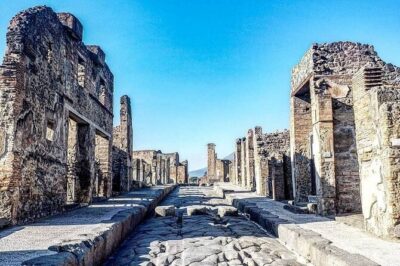
Pompeii Express Guided Tour by Train from Sorrento
Read our review →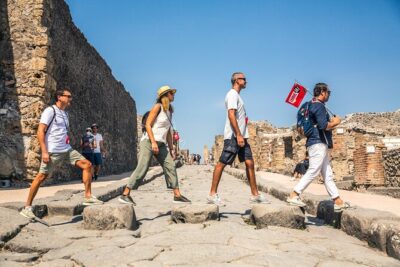
Skip-the-Line Pompeii Guided Tour from Sorrento
Read our review →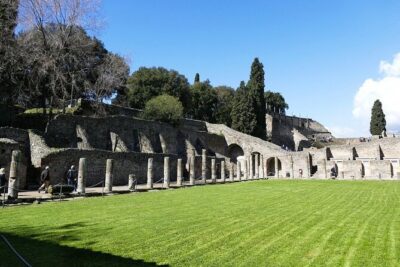
Pompeii Ruins Half-Day Tour from Sorrento with Guide
Read our review →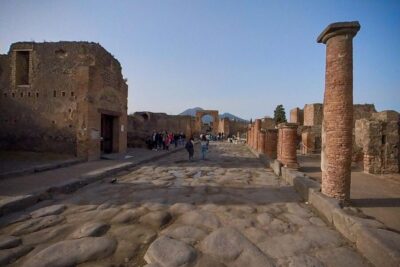
Pompeii and Vesuvius Guided Tour with Lunch
Read our review →
Day Tour to Pompeii Ruins and Mount Vesuvius
Read our review →Browse the lists this tour appears in