
Reviewed · POMPEII DAY TRIPS FROM SORRENTO
Guided Tour of Pompeii and Herculaneum with Lunch and Ticket
Pompeii and Herculaneum in one long day. This guided outing strings together Pompeii’s top sights and Herculaneum’s astonishingly preserved neighborhoods, plus a winery lunch that keeps the whole day from turning into nonstop ruins. You get an English-speaking guide route, included admissions for the major stops, and a mobile ticket that helps things feel organized even when the crowds are not.
The big drawback is that Pompeii can still be busy enough to slow you down, so your time can feel tight if you prefer wandering at your own pace rather than following a guided circuit. The tour keeps moving, and that is great for seeing a lot, but it is something to keep in mind.
In This Review
- Key highlights I think you will care about
- Sorrento to the ruins: why the 9-hour format works
- Pompeii essentials fast: Forum, Jupiter, and the city market
- Pompeii walk sequence: Via dell’Abbondanza, Stabian Baths, and a real brothel
- Teatro Grande and the eruption lesson in stone
- Winery lunch on the Vesuvius slopes: what you get and what it costs you
- Herculaneum’s “still there” effect: streets, villas, and the House of the Deer
- Neptune and Amphitrite mosaics, the Skeleton House, and the Augustales frescoes
- House of the Hotel and the Black Salon: big luxury, specific stories
- Practical pacing tips so Pompeii does not swallow your day
- Price and value: is $192.22 worth it?
- Should you book this Pompeii and Herculaneum tour?
- FAQ
- How long is the tour?
- Is the tour offered in English?
- Are entrance tickets included?
- What do you get for lunch and wine tasting?
- What group size should I expect?
- What happens if the weather is poor?
Key highlights I think you will care about
- Two archaeological cities, one day: You cover Pompeii and Herculaneum back-to-back, with about two hours at each site.
- Reserved entry for the main stops: Tickets are included for nearly everything on the route, and the day is structured to reduce friction.
- Real Roman daily life, not just monuments: Baths, the market (Macellum), the Lupanar, and theaters all show how people lived.
- A Vesuvius wine break that is actually pleasant: Lunch comes with wine tasting, and it functions as a reset mid-day.
- Herculaneum’s preservation makes details pop: Glass-paste mosaics, famous houses, and frescoed spaces are easier to understand there.
- Group stays compact: Maximum group size is listed as 100 travelers, which usually helps with staying together.
Sorrento to the ruins: why the 9-hour format works
You’re looking at a 9-hour day out of Sorrento, and the math makes sense. Pompeii and Herculaneum are both huge, and trying to do both solo in the same day often turns into logistics headaches. A guided route gives you a clear path through the chaos, and the included admissions remove a chunk of decision-making.
The tour is offered in English, and it includes a mobile ticket, which is practical if you are traveling light or moving between towns. Expect a group experience with up to 100 people, so you will want to stay close to your guide, especially when you hit dense areas like the Forum.
Finally, this is an outdoor day. Wear comfortable shoes, and if you are going in summer, bring sunglasses and sunscreen. Shade is limited in the open-air parts, and even with stops built in, the sun can still hit hard.
Pompeii essentials fast: Forum, Jupiter, and the city market
Pompeii is the headline for a reason. Even when you only have a couple of hours, the route hits the most meaningful spaces: the political and religious core, plus the commercial “everyday life” areas that explain how the city functioned.
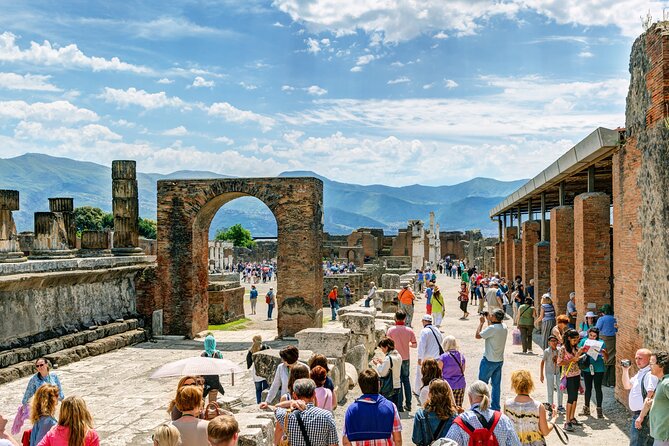
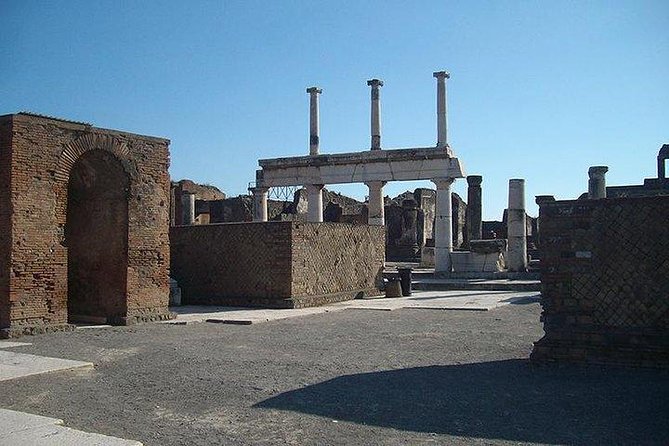
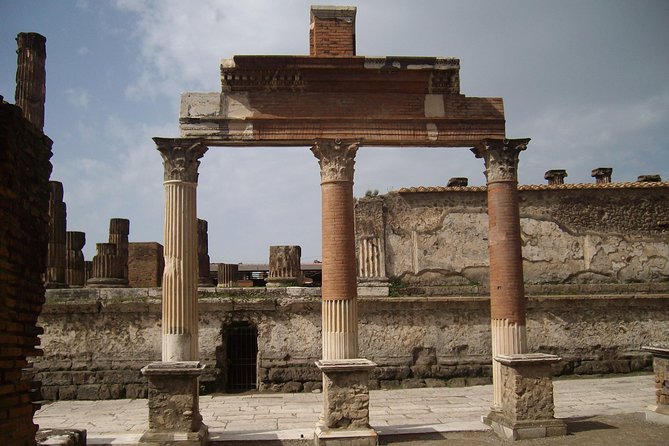
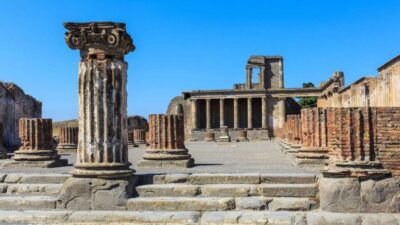
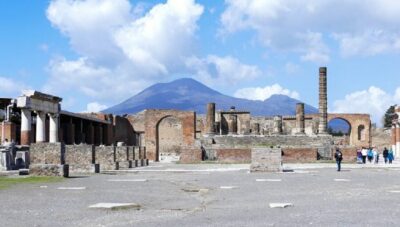
You start at the Archaeological Park of Pompeii, then move into the Forum area, which is basically the administrative and social center. This is where major public buildings for justice and city management would have been, alongside places of worship and commercial activity. It helps you connect Pompeii from street level to the bigger picture of Roman civic life.
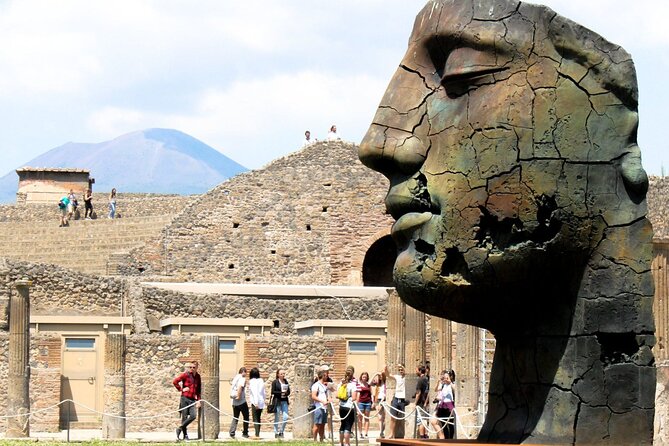
From there, you’ll see the Temple of Jupiter (Tempio di Giove Capitolino) on the northern side of the Forum. What makes this moment special is how it frames the landscape. Vesuvius rises behind the temple, so you are literally looking at the symbol of power and the volcano that changed everything.
Next up is the Macellum, the city’s market. This isn’t just a “here’s a building” stop. The market area is described as a tuff quadri-porticus with an elevated worship hall, and the porticoes were decorated with scenes from daily life, like selling fish and poultry, plus mythological subjects. The message is clear: food, trade, and religion all lived side by side.
If you want an easy mental trick, remember this: the Forum answers how the city ran, and the Macellum answers what people bought and talked about while it ran.
Smaller than Pompeii, just as frozen in time
- Guided Day Tour of Pompeii and Herculaneum with Light Lunch
★ 4.5 · 311 reviews - Sorrento: Pompeii & Herculaneum Tour with Skip-the-Line
★ 4.6 · 125 reviews - Pompeii, Herculaneum and Winery on Vesuvius with an Archaeologist
★ 5.0 · 89 reviews - Herculaneum: 2-Hour Skip-the-Line Tour from Sorrento
★ 4.0 · 46 reviews
Pompeii walk sequence: Via dell’Abbondanza, Stabian Baths, and a real brothel
After the Forum and market stops, you move along one of Pompeii’s best-known streets: Via dell’Abbondanza, the main road connecting the Forum to the Amphitheatre. It’s a helpful connector. Even in a guided sprint, it gives you a sense of scale and direction, so the sites feel like a living city grid instead of separate museum rooms.
Then comes one of my favorite “daily life” stops on the route: the Stabian Baths (Terme Stabiane). The baths were built in phases starting as far back as the 4th century BC, and the portion you can admire is tied to major 2nd-century BC rebuilding. What stands out is the layout you can actually visualize: courtyard, then a pool area, then colonnades leading into men’s quarters with a sequence of rooms (apodyterium, frigidarium, tepidarium, calidarium). Heating used piping through the walls and double floors that circulated hot air from furnaces and mobile braziers.
The baths were not just for cleaning. They were where people discussed politics, battles, trials, and women. So when you look at the rooms, you are also imagining conversation and routine, not just architecture.
From there, the route heads to the Lupanar, Pompeii’s brothel. It’s famous for its erotic paintings and its two-floor structure, including the owner and slaves on top, with rooms below featuring built-in beds. This stop is not everyone’s favorite topic, but it is historically important. It shows that Pompeii’s economy and social life included sex work, largely involving Greek and Oriental slaves, as the building design suggests.
If that subject makes you uncomfortable, it helps to approach it as context, not shock. The building’s function and design are part of what made it so recognizable.
Teatro Grande and the eruption lesson in stone
Next is the Teatro Grande, or Large Theatre. It dates to around the middle of the 2nd century BC, and it was significantly restored in Roman style. On the practical side, this is where you see how public entertainment worked in a real Pompeian setting: comedies and tragedies from Greek-Roman tradition.
One reason this theatre stop hits harder than you expect is the preservation story. It’s described as the first large public building freed from deposits of the eruption. That means when you stand there, you are not only seeing the theatre shape. You are also seeing the mark the eruption left on what survived.
For photographers, it’s also a good moment to slow down. The theatre can give you angles that work better than the street alleys and it helps you reset your eyes after the more detailed bath and brothel stops.
Winery lunch on the Vesuvius slopes: what you get and what it costs you
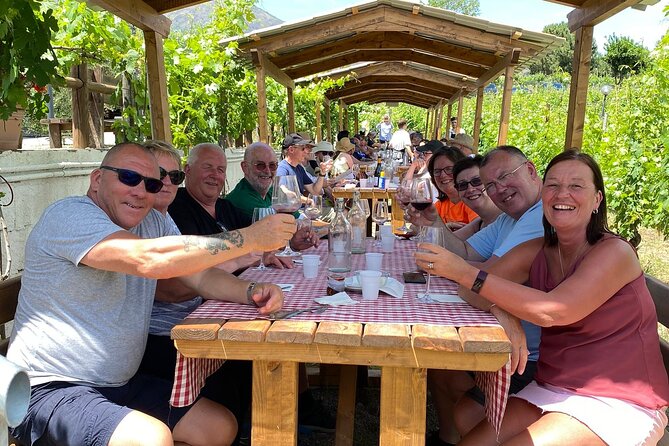
After Pompeii, you head to a winery stop: Sorrentino Winery (Sorrentino Vini). The operation is founded by Paolo Sorrentino and is described as having 35 hectares of property, all located within the Vesuvius National Park. The winery is linked with Lacryma Christi, highlighted as a DOC product (controlled designation of origin) produced on Vesuvius.
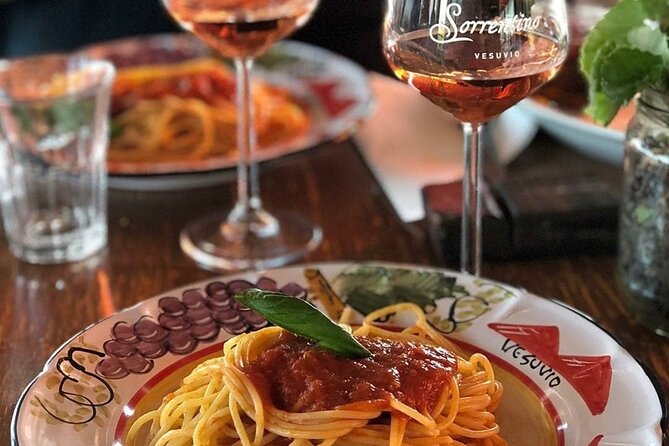
Now, let’s talk about the lunch, because this is where value can either feel great or feel like wasted time, depending on what you want from the day. Your sample menu is straightforward and local-leaning: bruschetta with cured meats, cheeses, and seasonal vegetables, then pasta with Piennolo cherry tomatoes, and a traditional homemade dessert. You also get a tasting of three wines: Prosecco, red, and white.
Here’s my balanced take. The lunch is not just food. It functions like a controlled pause so you do not burn out before Herculaneum. But yes, it does take time that could be spent in the ruins. A couple of people did feel that the winery break was a use of valuable time, especially when they were hoping for more site exploring.
If you enjoy a wine stop with a real reason to be there, this break is part of the overall experience. If you are trying to squeeze every minute of archaeology, you may wish it were shorter.
Walk streets frozen since 79 AD
Herculaneum’s “still there” effect: streets, villas, and the House of the Deer
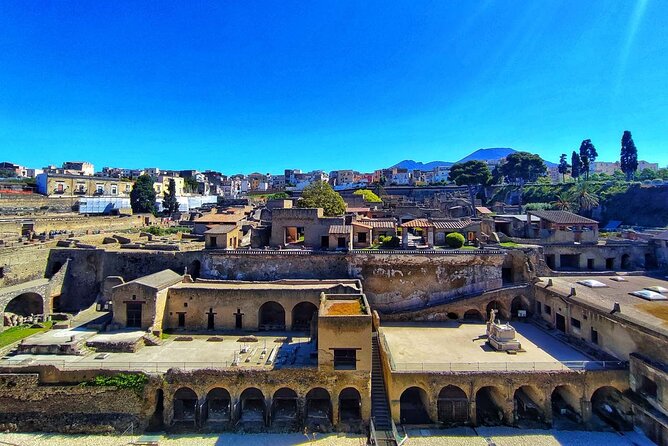
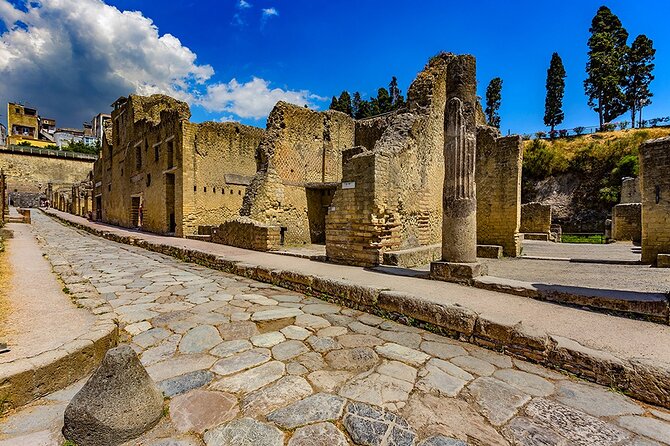
Herculaneum is the second act, and it is a very different experience from Pompeii. The ruins are described as still perfectly preserved, including streets, houses, and villas. That preservation changes how you understand the city. Pompeii often feels like dramatic remains in a large open place; Herculaneum feels more like a snapshot that never fully faded.
You’ll spend about two hours at Parco Acheologico Di Ercolano, then move through key houses and spaces. The tour starts with the big idea: smaller, sophisticated Roman city life preserved under meters of ash and pumice after Vesuvius in 79 AD.
One standout is the House of the Deer, linked to Q. Granius Verus. It has a sea view terrace and includes garden statues of deer being assaulted by a pack of dogs, which is how it earned its name. This is the kind of detail that makes preservation feel personal. You are seeing decorative choices, not just floor plans.
Neptune and Amphitrite mosaics, the Skeleton House, and the Augustales frescoes
Then you get to Casa di Nettuno e Anfitrite. This is an eye-catcher for a specific reason: mosaics made with glass paste, described as very expensive for the time. The artwork includes floral and hunting scenes, plus a central mosaic featuring Neptune and Amphitrite. The cost clue matters, because it tells you this home belonged to people who wanted luxury, display, and meaning.
After that comes Casa dello Scheletro, the Skeleton House, named for human remains discovered in a second-floor room in 1831. Even if the story is grim, it is a powerful reminder that these ruins are not just art and architecture. They are the remains of real people.
Next you’ll visit the Sacello degli Augustali. This small shrine or sacellum sits near the forum area and preserves splendid frescoes showing Hercules entering Olympus, with Jupiter, Juno, Minerva, and Hercules against Achelous. It is also connected to a striking discovery: the janitor’s skeleton was found in his room lying on the bed.
If you want one practical takeaway, it’s this: Herculaneum’s preserved decorative programs help you understand what people valued. Pompeii often tells you what happened. Herculaneum helps you picture what it looked like before the moment ended.
House of the Hotel and the Black Salon: big luxury, specific stories
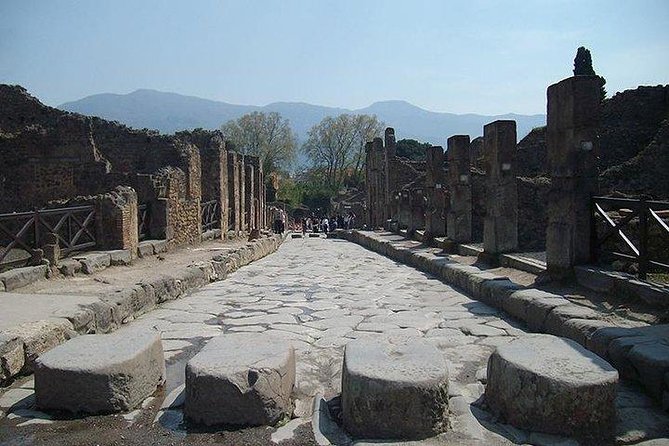
The route then takes you to larger residential spaces that give you a sense of wealth and daily structure. The House of the Hotel is described as the largest house of Herculaneum discovered so far, with about 2,250 square meters. It sits on the edge of the hill in a panoramic position and includes a spa district, which is why it was first considered a hotel. This stop helps you understand how much space upper-status families could control, including leisure facilities within the residence.
Finally, you’ll see Casa del Salone Nero, the House of the Black Salon. It gets its name from a party hall painted entirely black with geometric patterns. It also connects to waxed tablets of L. Venidius Ennychus, described as possibly the owner. Those tablets include details about eligibility for Augustale, the purchase of a slave, and the birth of a daughter.
That combination of visual design plus written documents is unusual in archaeology tours. It gives you both sides of the story: what the space looked like and how life inside it was structured.
Practical pacing tips so Pompeii does not swallow your day
This is where your expectations matter. Pompeii is crowded in general, and even with reserved entry and a plan, your time can get squeezed. One of the big lessons from the experiences on this route is simple: the pace works best when you treat it as a highlights tour, not a slow wander.
Here are a few ways to make it work for you:
- Stay close when the group tightens. Pompeii’s narrow areas and dense clusters can make it hard to regroup if you drift.
- Use your energy on the “decision stops.” Forum, baths, and major theatre spaces are the best anchors for meaning. When you hit these, take a breath and look around.
- Expect heat and plan for shade. One guide approach described included finding shade while explaining, and that can make a huge difference when the sun is relentless.
- Be okay with selective detail. You can only see so much in two hours, so focus on the stops that explain life rather than trying to absorb every wall.
If you really want to go slow, consider splitting Pompeii and Herculaneum into separate days. But if your time is limited, this is a smart way to do both without losing half your day to planning.
Price and value: is $192.22 worth it?
At about $192.22 per person for a full 9-hour day, you are paying for more than transportation. The value comes from three things you do get here: included admissions for most major stops, a guided route that helps you understand what you are looking at, and lunch with wine tasting.
That said, value depends on your tolerance for structure. If you want deep, slow exploration, the winery break and the guided timing can feel like friction. If you want a guided best-of day that reduces guesswork, it is a reasonable price for packing in two top archaeological sites, meals included, and enough coaching to make it meaningful.
Also, having a mobile ticket helps the day feel smoother. It saves time when your schedule is already full.
Should you book this Pompeii and Herculaneum tour?
Book it if you:
- Want one-day access to both Pompeii and Herculaneum.
- Like guided context, especially for daily life spaces like baths and markets.
- Enjoy a winery stop with lunch and a small wine tasting.
- Are traveling with limited time and want a path that minimizes decision stress.
Skip or rethink if you:
- Plan to do lots of slow roaming and want control over every minute.
- Are highly sensitive to crowds and long lines, since Pompeii can be unpredictable.
- Prefer constant narration and worry you might be disappointed if the bus ride is quieter.
If your goal is to see the biggest stories of these sites in a single day, this tour is a strong, practical option. It is not pretending to be leisurely, and that honesty is part of why it works.
FAQ
How long is the tour?
The tour runs about 9 hours.
Is the tour offered in English?
Yes, it is offered in English.
Are entrance tickets included?
Admission tickets are included for most stops on the route. Casa di Nettuno e Anfitrite and House of the Hotel are listed as admission ticket free.
What do you get for lunch and wine tasting?
The lunch includes bruschetta with cured meats, cheeses, and seasonal vegetables, pasta with Piennolo cherry tomatoes, and a traditional homemade dessert, plus a tasting of three wines (Prosecco, red, and white).
What group size should I expect?
The tour has a maximum of 100 travelers.
What happens if the weather is poor?
This experience requires good weather. If it is canceled due to poor weather, you will be offered a different date or a full refund.
Lunch with a Bay View
- Capri Boat Tour from Sorrento: Swim, Grottos & Light Lunch
★ 5.0 · 1,201 reviews - Amalfi Coast Day Tour from Sorrento with Light Lunch and Wine
★ 4.5 · 1,148 reviews - From Sorrento: Pompeii and Vesuvius Guided Tour with Lunch
★ 4.8 · 683 reviews - Positano & Amalfi Boat Tour from Sorrento: Swim & Light Lunch
★ 5.0 · 399 reviews
New on the Sorrento coast





Pompeii Day Trips from Sorrento, compared.
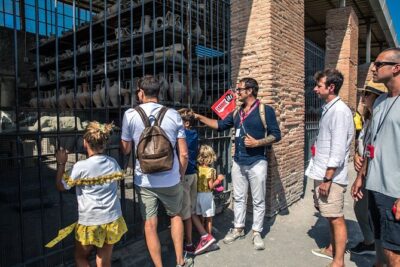
Priority Access Pompeii & Mt. Vesuvius Full day from Sorrento
Read our review →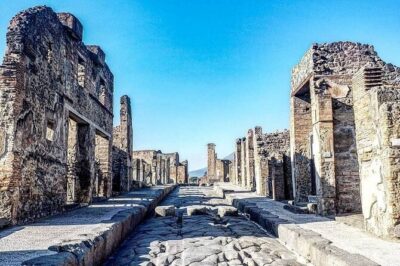
Pompeii Express Guided Tour by Train from Sorrento
Read our review →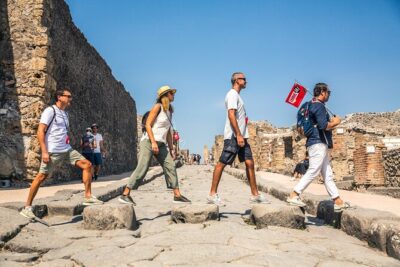
Skip-the-Line Pompeii Guided Tour from Sorrento
Read our review →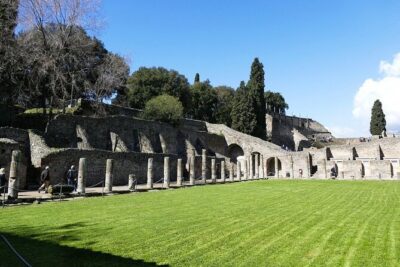
Pompeii Ruins Half-Day Tour from Sorrento with Guide
Read our review →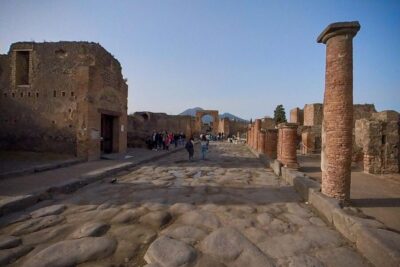
Pompeii and Vesuvius Guided Tour with Lunch
Read our review →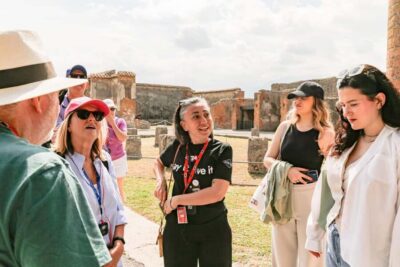
Day Tour to Pompeii Ruins and Mount Vesuvius
Read our review →Browse the lists this tour appears in